What we are solvingCapacitors: the farad, dielectric strength, uses of dielectrics, energy changes on charging, p.d. across capacitors in series, removing a dielectric, and comparing capacitances
Given for (d):
C=16 μF with wood (
εr=4), p.d. 6000 V connected across the plates
Chapter: Capacitors
Topic: Capacitance, dielectrics and energy
(a)(i) (1 mark)The farad is the capacitance of a capacitor which stores a charge of 1 coulomb when the p.d. across its plates is 1 volt
(a)(ii) (1 mark)Dielectric strength is the maximum electric field (potential gradient) a dielectric can withstand without breaking down and conducting (
V m−1)
(b)(i) (2 marks)It increases the capacitance (it reduces the field and p.d. for a given charge)
It keeps the plates apart so they can be very close without touching, and allows a higher working voltage (higher dielectric strength than air)
(b)(ii) (2 marks)Chemical energy in the battery is changed to electrical energy; half of the energy given by the battery (
QV) is stored as electrical potential energy in the electric field between the plates (
21QV)
The other half is changed to heat in the resistance of the connecting wires (and a little to electromagnetic radiation)
(c) (3 marks)In series the capacitors carry the same charge
Q, and their p.d.s add up to
E:
E=V1+V2=C1Q+C2Q=QC1C2C1+C2Q=C1+C2C1C2EV1=C1Q=(C1+C2C2)E(d)(i) (2 marks)C=εrC0 ⇒ C0=416=4 μF(d)(ii) (4 marks)The p.d. of 6000 V stays connected, so use
W=21CV2 at constant
VW1=21×16×10−6×60002=288 JW2=21×4×10−6×60002=72 JΔW=288−72=216 J (the stored energy falls)(d)(iii) (1 mark)As the wood is withdrawn the capacitance falls, so charge (
0.096−0.024=0.072 C) flows back into the supply; the 216 J given up by the capacitor, together with the work done in pulling the wood out, is returned to the supply (
QV=0.072×6000=432 J)
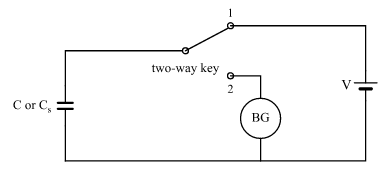
(e) (4 marks)Charge the standard capacitor
Cs from a battery of p.d.
V (key at 1), then switch the key to 2 to discharge it through a ballistic galvanometer; record the first throw
θsReplace
Cs with the unknown capacitor
C, charge it from the same battery and discharge it through the galvanometer; record the throw
θThe first throw is proportional to the charge:
θ∝Q=CV, and
V is the same
CsC=θsθ ⇒ C=θsθCsRepeat several times and take the mean
Answer: (c)
V1=C1+C2C2E; (d)(i)
4 μF; (d)(ii) energy falls by 216 J; (e)
C=θsθCsTip: If the capacitor were disconnected before the wood was pulled out,
Q would stay fixed and the energy would rise from 288 J to 1152 J, the extra coming from the work done pulling the wood out