What we are solvingPart I: a metre rule hangs from a thread at its balance point
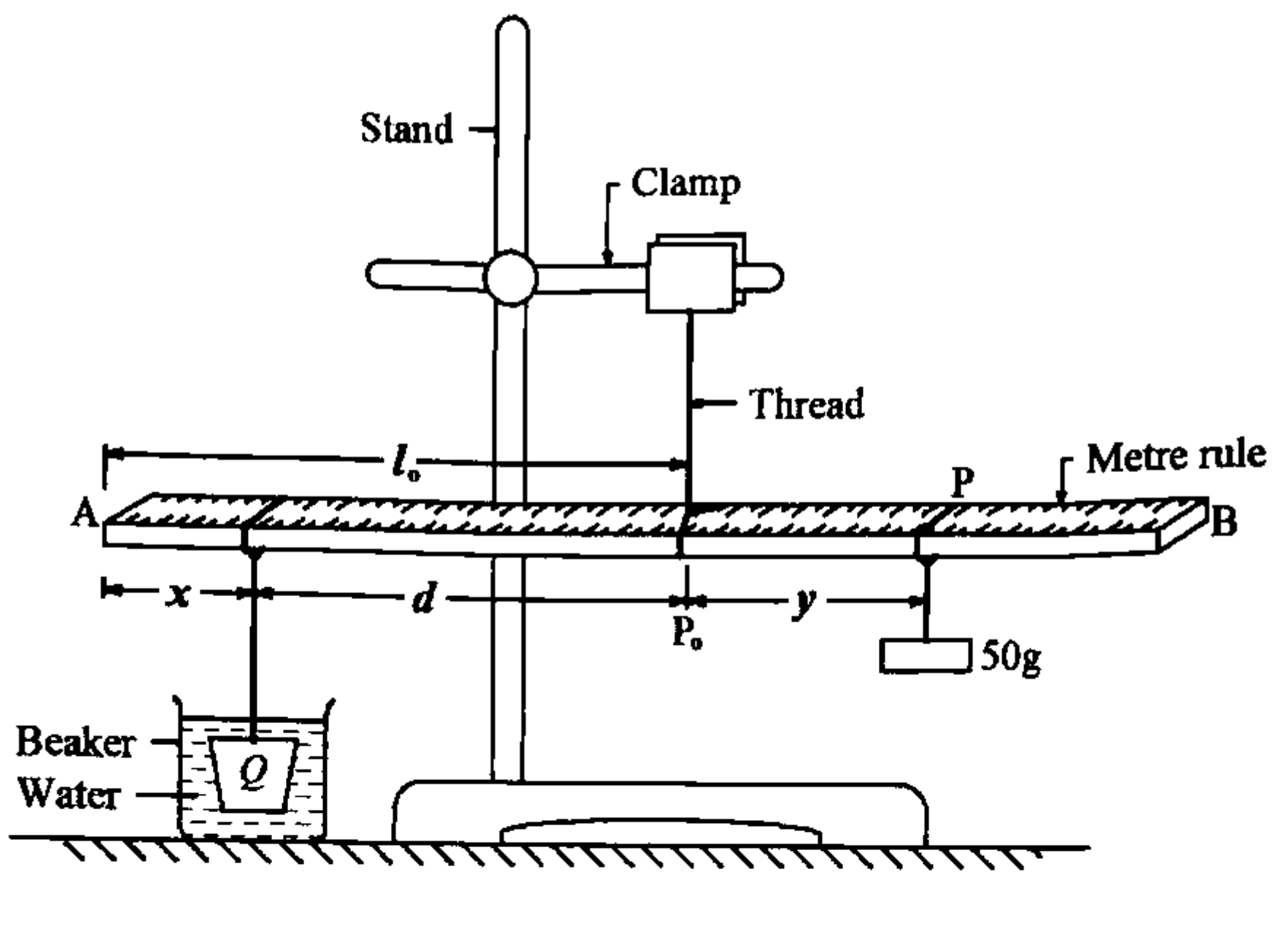
P0Solid Q (mass
M) hangs in water on one side; a
50 g mass hangs on the other side
We take pairs of distances
d and
y, plot
y against
d and use the slope
s1 to find
αPart II: a spring stretches when water and then liquid L are poured into a beaker hanging from it
We compare the extensions to find
βChapter: Mechanics and properties of matter
Topic: principle of moments, Archimedes' principle, Hooke's law, relative density
Concept and formulasPrinciple of moments: for a body in equilibrium, sum of clockwise moments = sum of anticlockwise moments about any point
Archimedes' principle: a body in a fluid loses weight equal to the weight of fluid it displaces
Hooke's law: extension of a spring is proportional to the load,
F=keRelative density = density of substance / density of water
Part I: theory (why the expression works)The rule balances on its own at
P0, so its own weight gives no moment about
P0Let
mw = mass of water displaced by Q (in g)
Apparent weight of Q in water:
W′=(M−mw)gQ hangs at distance
d from
P0; the
50 g mass at distance
yMoments about
P0:
(M−mw)gd=50gyy=50M−mwdSo
y against
d is a straight line through the origin with slope
s1=50M−mw⇒mw=M−50s1α=M−50s1M=mwM=upthrust in waterweight in airSo
α is the relative density of Q
Part I: procedure and readingsSample readings (your own readings will differ)
(a) Weigh Q on the balance provided:
M=60.0 g(b) Tie a thread round the metre rule and hang it from the clamp
(c) Slide the thread loop along the rule until the rule rests horizontally
(d) Read the thread position from end A:
l0=50.0 cm(e) Put about
200 cm3 of water in the beaker
(f) Hang Q with thread at
x=10.0 cm from A, fully under the water
(g) Hang the
50 g mass at P on the side of end B
(h) Slide P until the rule is horizontal again; Q must not touch the beaker
(i) d = distance from Q's thread to
P0 (
d=l0−x):
d=40.0 cm(j) y = distance from
P0 to P:
y=28.9 cm(k) Repeat for
x=15.0,20.0,25.0,30.0,35.0 cm(l) Table of results:
| x (cm) | d (cm) | y (cm) |
|---|
| 10.0 | 40.0 | 28.9 |
| 15.0 | 35.0 | 25.1 |
| 20.0 | 30.0 | 21.7 |
| 25.0 | 25.0 | 17.9 |
| 30.0 | 20.0 | 14.5 |
| 35.0 | 15.0 | 10.8 |
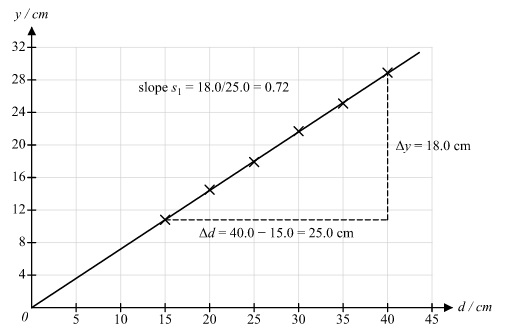
(m) Plot
y (vertical axis) against
d (horizontal axis); draw the best straight line
(n) Slope from two points far apart on the line,
(15.0,10.8) and
(40.0,28.8):
s1=40.0−15.028.8−10.8=25.018.0=0.72(o) Substitute in the expression:
α=M−50s1M=60.0−50×0.7260.0α=60.0−36.060.0=24.060.0=2.5α has no unit (it is a ratio); a value near 2.5 is typical of glass or stone
Part II: theoryHooke's law: extension
e∝ load, so
e∝ mass of liquid added
Equal volumes
V: mass of water
=Vρw, mass of L
=VρLeweL=VρwVρL=ρwρLThe same holds for
100 cm3:
ew′eL′=ρwρL2β=eweL+ew′eL′⇒β=mean of the two ratiosSo
β is the relative density of liquid L
Part II: procedure and readingsSample readings (your own readings will differ)
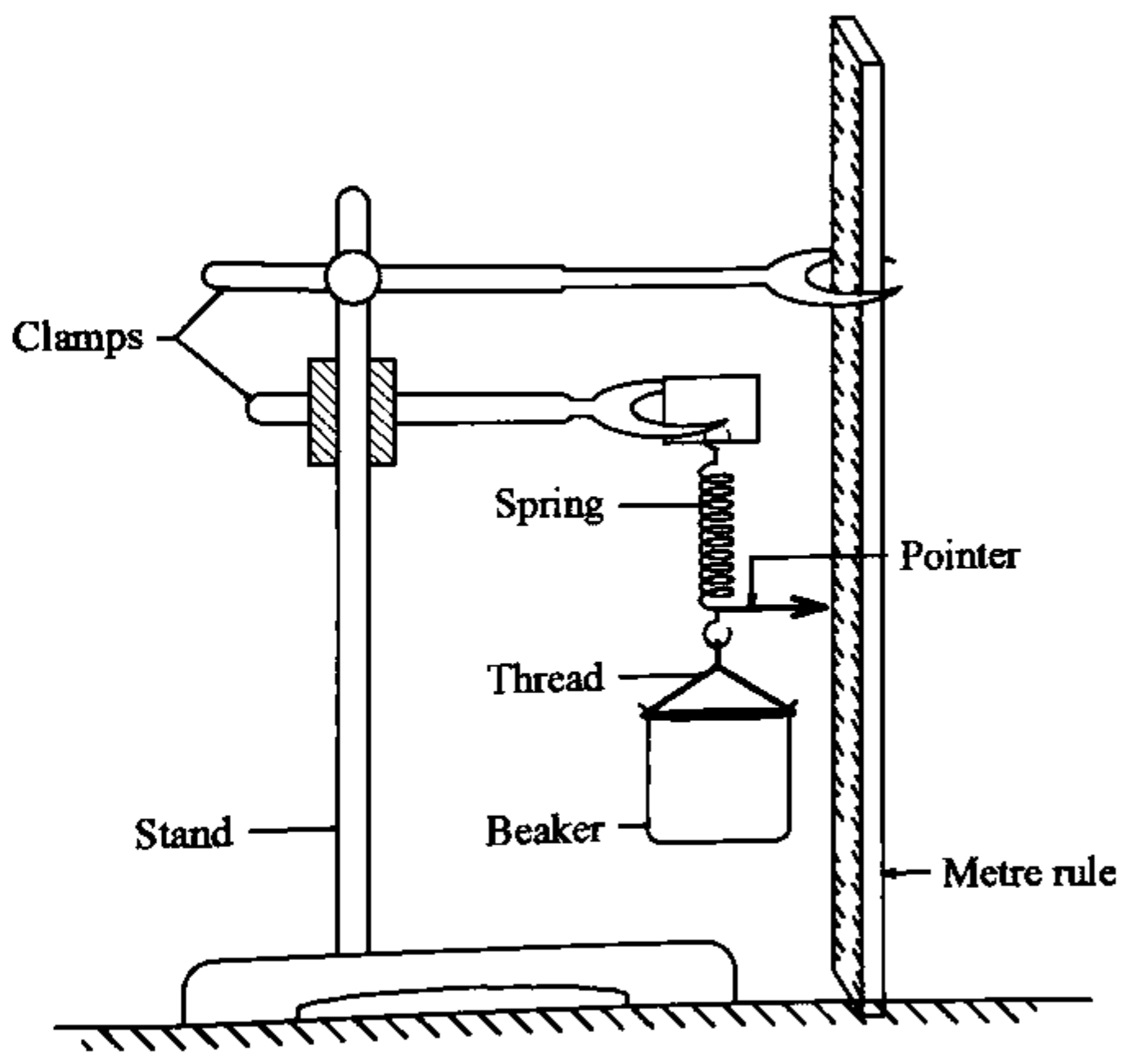
(a) Clamp the spring between two pieces of wood so it hangs vertically beside the vertical metre rule
(b) Hang the empty, dry beaker from the spring with the thread
(c) Read the pointer with the eye level with it:
K0=25.0 cm(d) Measure
150 cm3 of water with a measuring cylinder and pour it in
(e) When the beaker is still:
Kw=37.0 cm(f) ew=Kw−K0=37.0−25.0=12.0 cm(g) Empty the beaker and pour in
100 cm3 of water
(h) Kw′=33.0 cm(i) ew′=Kw′−K0=33.0−25.0=8.0 cm(j) Pour out the water and dry the beaker with tissue paper (left-over water would add mass)
(k) Hang the empty beaker again and re-read
K0:
K0=25.0 cm(l) Pour in
150 cm3 of liquid L
(m) KL=34.7 cm(n) eL=34.7−25.0=9.7 cm(o) Empty the beaker and pour in
100 cm3 of liquid L
(p) KL′=31.4 cm(q) eL′=31.4−25.0=6.4 cm| Volume (cm³) | Liquid | Pointer reading (cm) | Extension (cm) |
|---|
| 0 | none | K0=25.0 | 0 |
| 150 | water | Kw=37.0 | ew=12.0 |
| 100 | water | Kw′=33.0 | ew′=8.0 |
| 150 | L | KL=34.7 | eL=9.7 |
| 100 | L | KL′=31.4 | eL′=6.4 |
(r) Calculate
β:
2β=12.09.7+8.06.4=0.808+0.800=1.608β=21.608=0.80A relative density of about 0.8 is typical of paraffin (kerosene)
(s) Two sources of error, explained:
1. Parallax when reading the pointer: if the eye is not level with the pointer, each K is read too high or too low, so every extension is wrong
2. Volume errors: reading the measuring cylinder away from the bottom of the meniscus, or drops left in the beaker, change the mass added, so the extension does not match the stated volume
(Also accepted: the spring still oscillating when read; the spring stretched beyond its elastic limit so
K0 shifts)
ConclusionConstant
α of Q (its relative density)
≈2.5Constant
β of L (its relative density)
≈0.80Answer: Sample values:
s1=0.72,
α≈2.5;
β≈0.80 (your values come from your own readings)
Tip: Take the slope from a large triangle on the best line, not from two table points