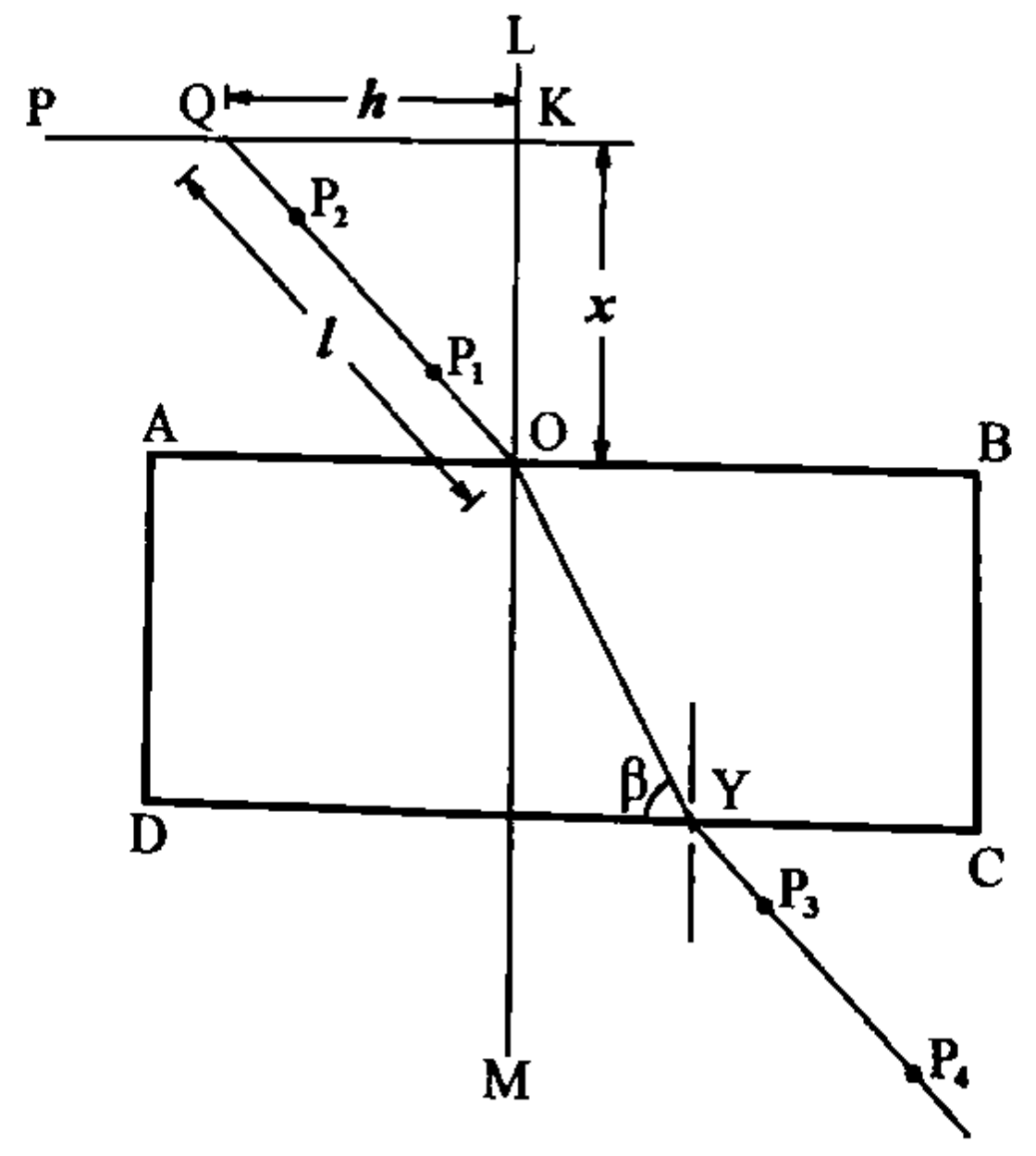
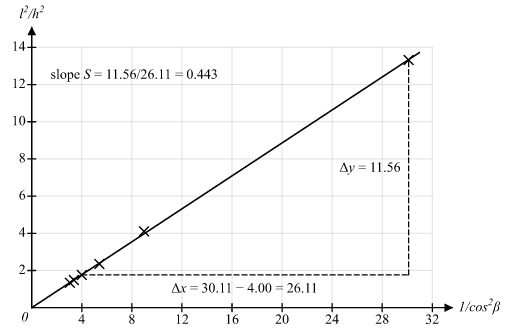
What we are solvingA ray is sent into a glass block along QO at different anglesFor each ray we measure the length l = QO and the angle β that the emerging ray makes with face DC at YWe plot h2l2 against cos2β1; its slope S gives μChapter: Geometrical opticsTopic: refraction through a parallel-sided glass block, refractive indexConcept and formulasSnell's law: sini=μsinr (i = angle of incidence in air, r = angle of refraction in glass)μ = refractive index of the glass (no unit)Theory (why the expression works)In the right-angled triangle QKO: QK =h, OK =x, QO =lThe angle of incidence i is the angle between QO and the normal LOM:sini=QOQK=lhOY is the refracted ray; β is its angle with the face DC, which is perpendicular to the normalSo the angle of refraction is r=90∘−β and sinr=cosβlh=μcosβ⇒h2l2=μ21⋅cos2β1A graph of h2l2 against cos2β1 is a straight line through the origin with slope S=μ21Working: procedure(a) Pin the white sheet flat on the soft board(b) Lay the block on its broad face and trace its outline ABCD with a sharp pencil(c) Remove the block; mark O on AB, 4.0cm from A, and draw the normal LOM through O with a set square(d) Mark K on the normal outside the block with OK =x=7.0cm(e) Draw line PQK through K, perpendicular to LOM (parallel to AB)(f) Mark Q on PK with QK =h=2.0cm(g) Draw the straight line QO(h) Measure QO: l=7.3cm (check: 7.02+2.02=7.28)(i) Stick P1 and P2 upright on QO, well apart(j) Put the block back exactly on its outline(k) Look through face DC; stick P3 and P4 so that they and the images of P1, P2 are in one straight line (line up the pin bases)(l) Remove the block(m) Draw a line through P3 and P4 to meet DC at Y(n) Join Y to O (the ray inside the glass)(o) Measure β, the angle between YO and the face DC at Y, with a protractor: β=79.5∘(p) Repeat for h=4.0,6.0,8.0,10.0,12.0cm (each time also doing (n) and (o) to get β)Working: resultsSample readings (your own readings will differ), x=7.0cm(q) Table of results:
h (cm)
l (cm)
β (°)
h2l2
cosβ
cos2β1
2.0
7.3
79.5
13.32
0.1822
30.11
4.0
8.1
70.5
4.10
0.3338
8.97
6.0
9.2
64.5
2.35
0.4305
5.40
8.0
10.6
60.0
1.76
0.5000
4.00
10.0
12.2
57.0
1.49
0.5446
3.37
12.0
13.9
55.0
1.34
0.5736
3.04
Example row, h=2.0: h2l2=2.027.32=4.0053.29=13.32; cos79.5∘=0.1822, 0.182221=30.11(r) Plot h2l2 (vertical) against cos2β1 (horizontal); draw the best straight line
(s) Slope from (4.00,1.76) and (30.11,13.32):S=30.11−4.0013.32−1.76=26.1111.56=0.443(t) From S=μ21:μ=S1=0.4431=0.6661=1.50(u) Comment on the procedure and results:The graph is a straight line through the origin, which confirms Snell's law sini=μsinrμ≈1.5 agrees with the usual refractive index of glass (about 1.5)Accuracy needs: pins upright and well apart, sharp pencil lines, the block put back exactly on its outline, and pin bases (not tops) lined upFor h=2.0cm, β is close to 90∘, so a 0.5∘ error in β changes cos2β1 a lot: that point is the least reliableThe other points crowd near the origin; values of h between 2 and 4 cm would spread them betterConclusionThe refractive index of the glass block is μ≈1.50Answer: Sample values: S=0.443, μ=1/S≈1.50Tip:β is measured from the block face, not from the normal, so the angle of refraction is 90∘−β