What we are solvingA beaker hangs from a metre rule; its mass is the constant
α (in kg)
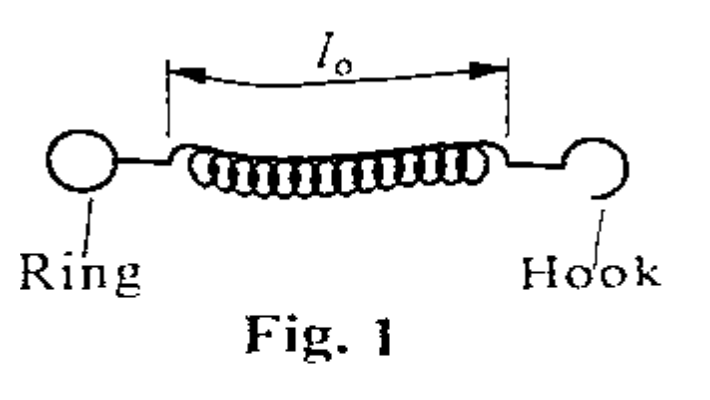
A spring with mass
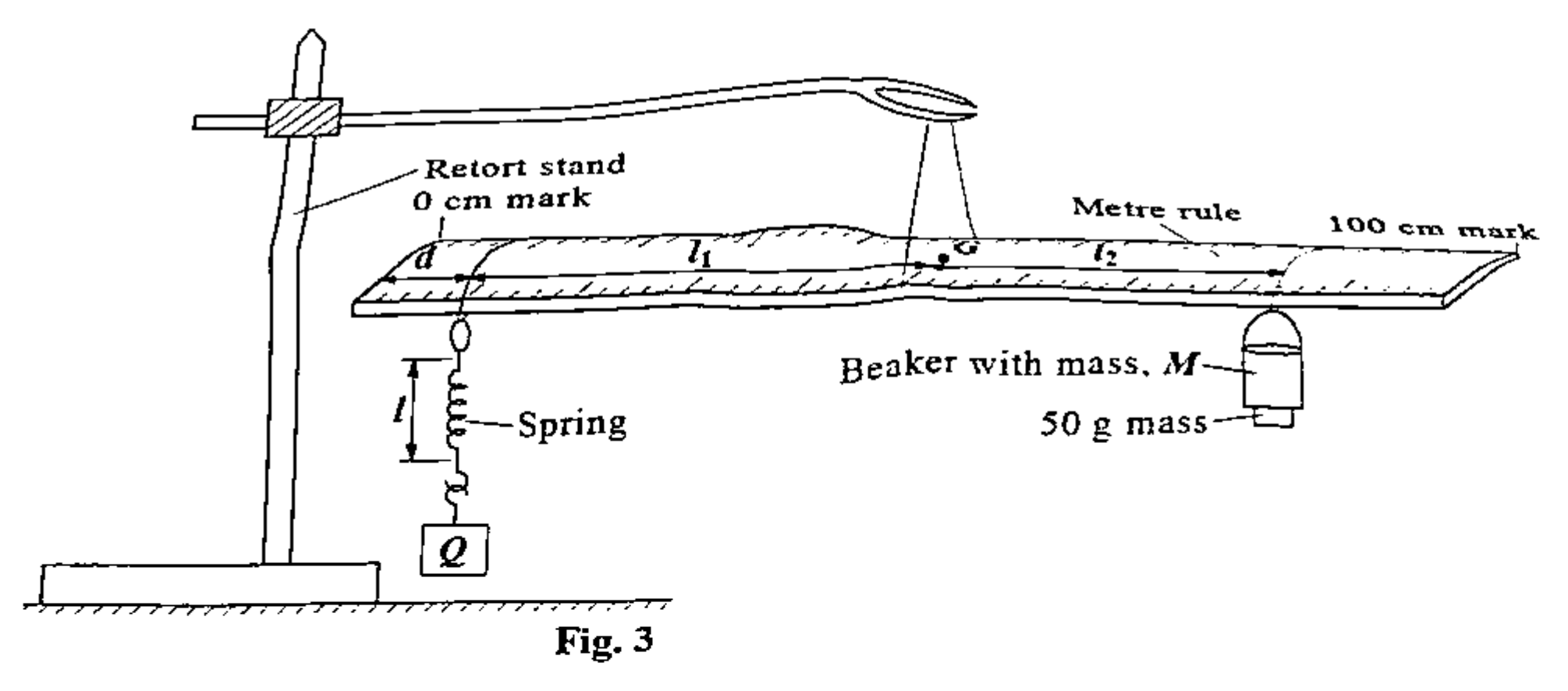
Q on it balances the beaker by moments
Method I: a graph gives the spring constant
β and
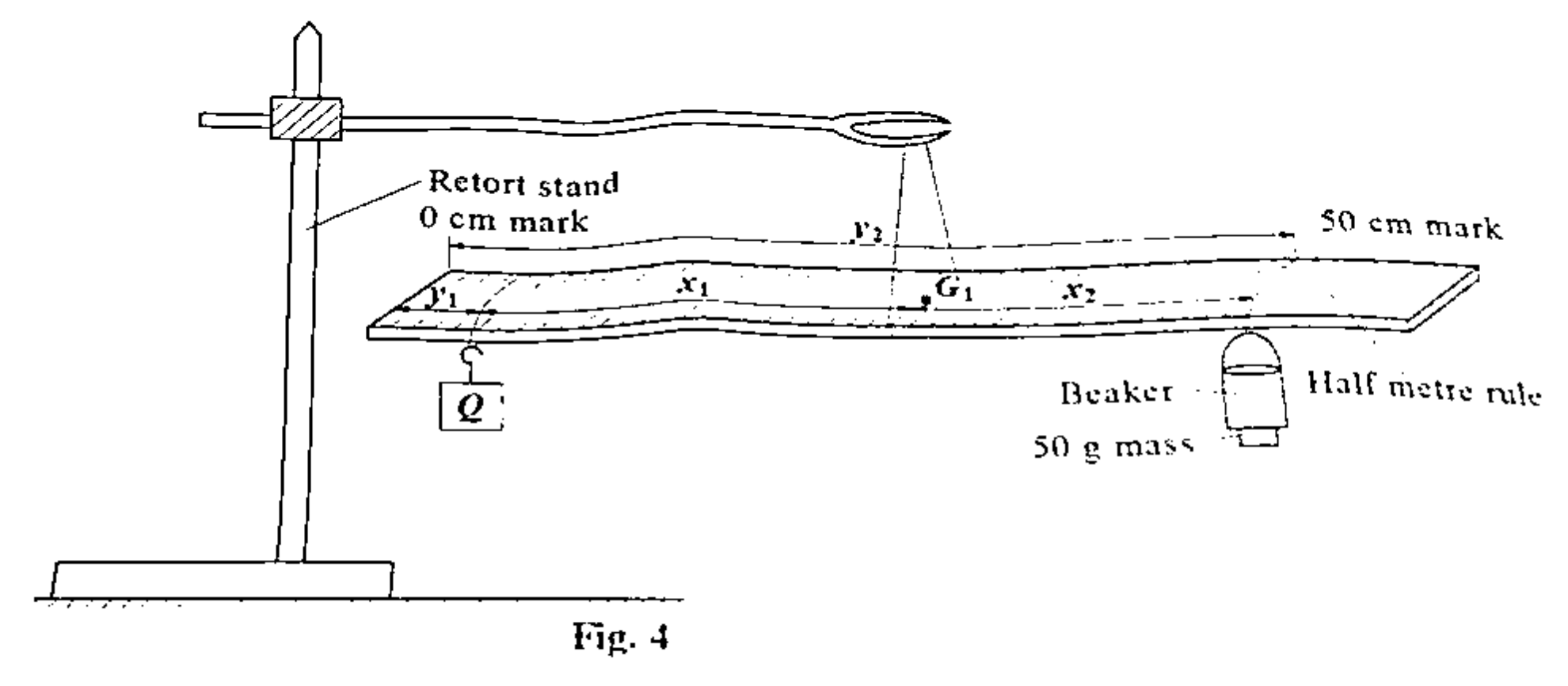
α1Method II: one balance on a half metre rule gives
α2Chapter: Mechanics (practical)
Topic: principle of moments and Hooke's law
Concept and formulasHooke's law: the spring holding
Q has tension
T=βeβ = spring constant (N m
−1),
e = extension (m)
Principle of moments: for balance, clockwise moments = anticlockwise moments about the pivot
The loop stays at
G, the centre of gravity of the rule, so the rule's own weight has no moment
Moments about
G (beaker load =
M+α+0.050 kg):
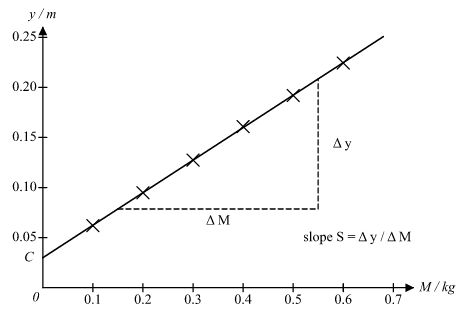
βel1=(M+α+0.050)gl2y=el2l1=βgM+βg(α+0.050)So
y against
M is a straight line:
S=βg ⇒ β=Sg,C=βg(α+0.050) ⇒ α1=gCβ−0.050Method II, moments about
G1 (
Q = 0.150 kg, as the
α2 formula shows):
0.150gx1=(α+0.050)gx2 ⇒ α2=x20.150x1−0.050x2WorkingSample readings (your own readings will differ)
METHOD I(a) Lay the spring on the bench and measure its coiled length with the metre rule
l0=5.0 cm
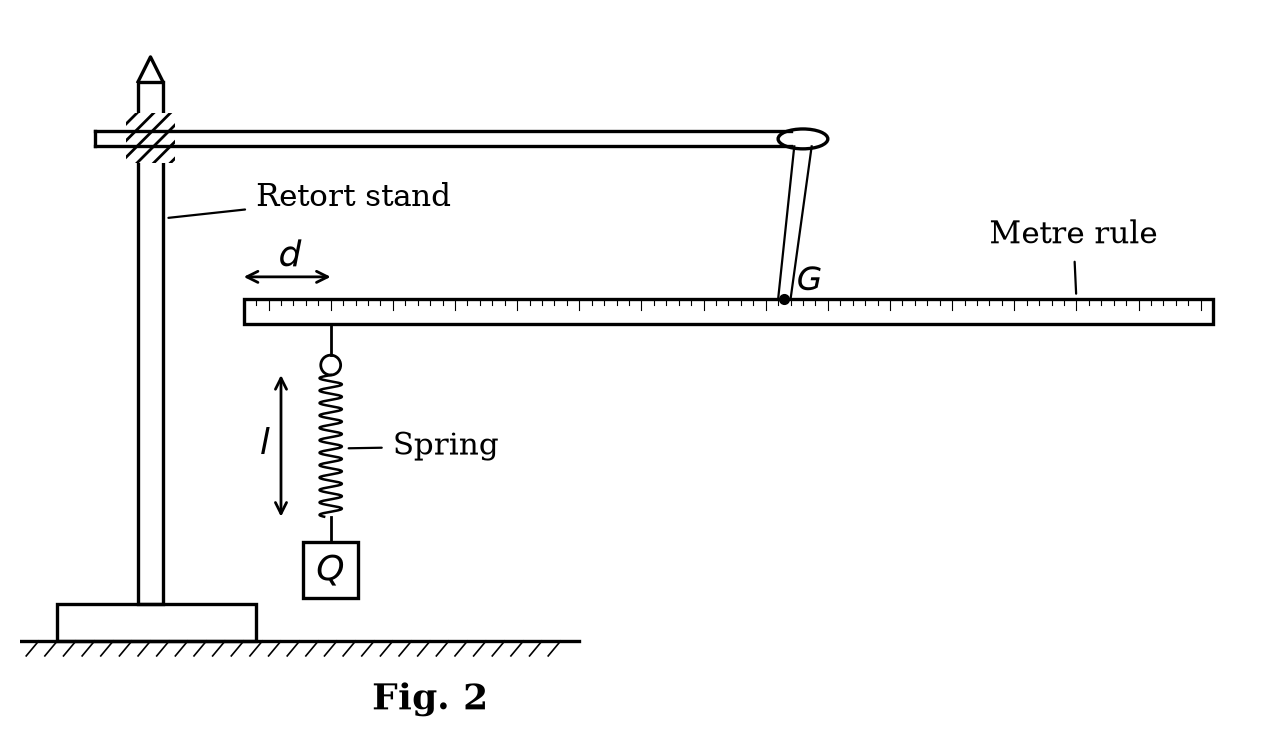
(b) to (d) Hang the metre rule by the thread loop and slide the loop until the rule is horizontal
Balance point:
G=50.0 cm
(e) to (g) Hang the spring at
d=17.5 cm, hang
Q on it and balance the rule again
(h) New length of the spring:
l=9.9 cm
(i) Extension in metres:
e=l−l0=9.9−5.0=4.9 cm=0.049 m(j) Move the loop back to
G (50.0 cm), so the rule's weight acts at the pivot
(k) l1 = distance from the spring to
G:
l1=G−d=50.0−17.5=32.5 cm=0.325 m(l), (m) Fix the 50 g mass under the beaker with sellotape and hang the beaker on the other side of
G(n) to (q) For each
M, slide the beaker until the rule balances and read
l2 (beaker to
G)
(r) Table of results (
e=0.049 m,
l1=0.325 m):
| M (kg) | l2 (cm) | l2 (m) | l1/l2 | y=el1/l2 (m) |
|---|
| 0.100 | 25.7 | 0.257 | 1.265 | 0.0620 |
| 0.200 | 16.8 | 0.168 | 1.935 | 0.0948 |
| 0.300 | 12.5 | 0.125 | 2.600 | 0.1274 |
| 0.400 | 9.9 | 0.099 | 3.283 | 0.1609 |
| 0.500 | 8.3 | 0.083 | 3.916 | 0.1919 |
| 0.600 | 7.1 | 0.071 | 4.577 | 0.2243 |
(s) Plot
y (vertical axis) against
M; the points lie on a straight line:
(t) Slope from a large triangle on the line, from
M=0.15 to
M=0.55 kg:
S=ΔMΔy=0.55−0.150.2085−0.0786=0.400.1299=0.325 m kg−1(u) Spring constant:
β=Sg=0.3259.81=30.2 N m−1(v) Intercept on the
y-axis:
C=0.030 m
(w) Constant from Method I:
α1=gCβ−0.050=9.810.030×30.2−0.050=0.0924−0.050=0.042 kgMETHOD II(a), (b) Balance the half metre rule alone on the loop:
G1=25.0 cm
(c), (d) Keep the loop at
G1; hang
Q on the left and the beaker (with the 50 g mass) on the right; move them until the rule is horizontal
(e) Readings from the zero end:
y1=13.0 cm,
y2=45.0 cm
(f) Distances from the pivot:
x1=G1−y1=25.0−13.0=12.0 cm,x2=y2−G1=45.0−25.0=20.0 cm(g) (the ratio of lengths means cm can stay)
α2=20.00.150×12.0−0.050×20.0=20.01.80−1.00=0.040 kg(h) Mean value:
α=21(α1+α2)=21(0.042+0.040)=0.041 kgα is the mass of the empty beaker, about 41 g
Answer: (sample readings)
β≈30 N m−1,
α1≈0.042 kg,
α2≈0.040 kg,
α≈0.041 kg
Tip: Always put the loop back at
G before hanging the beaker; then the weight of the rule drops out of the moments
Tip: Read the slope from a large triangle, not from two table points