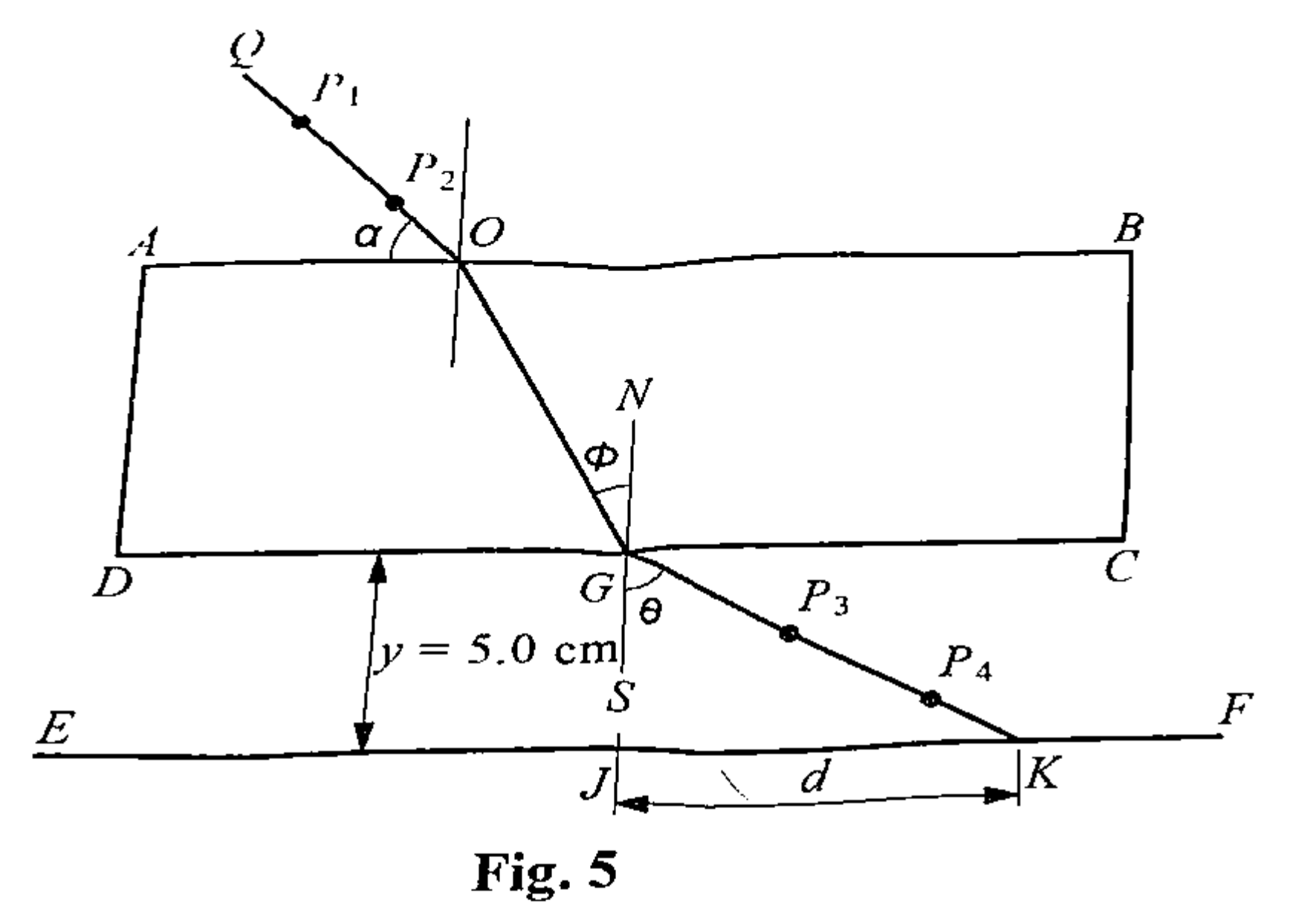
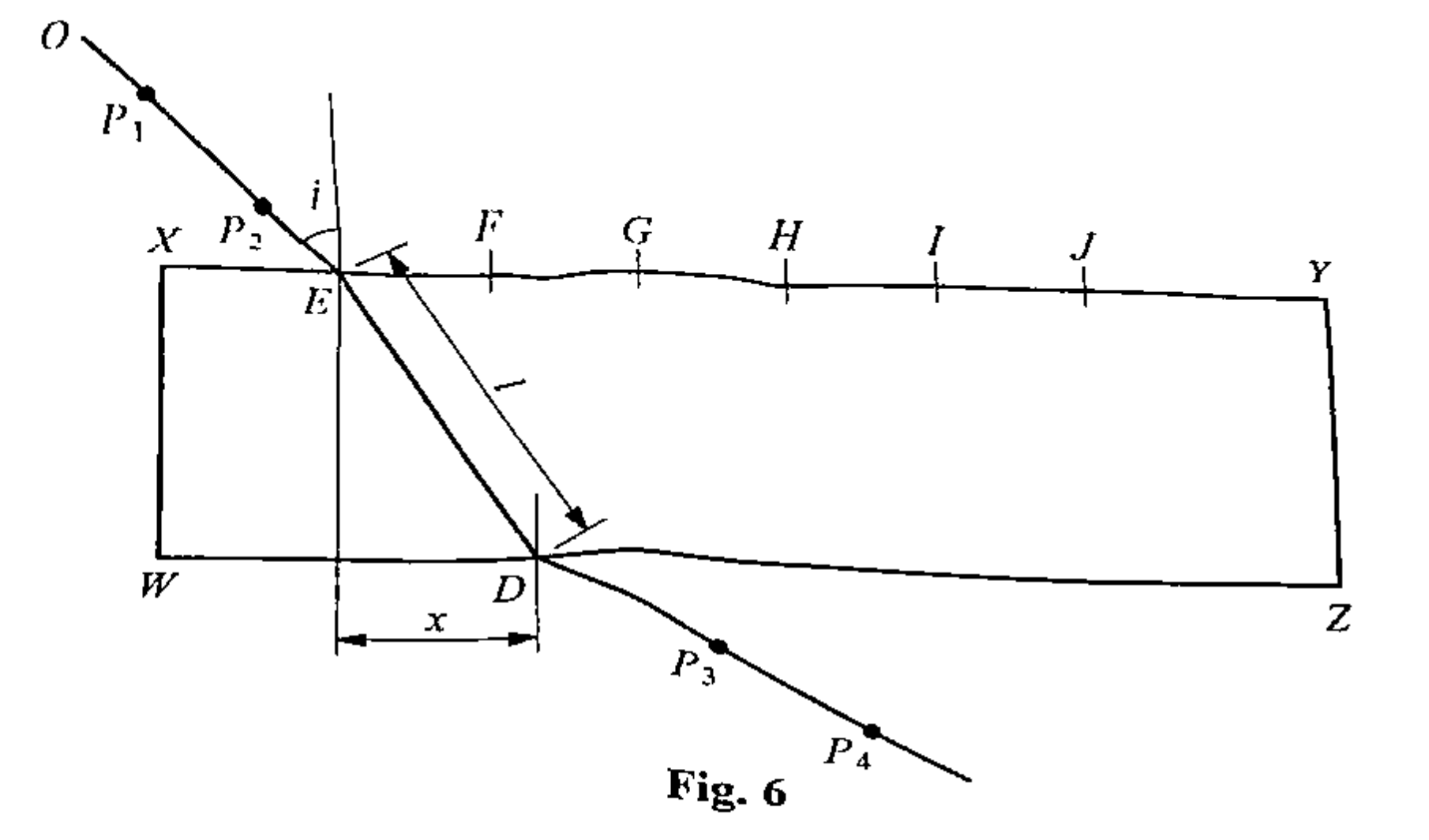
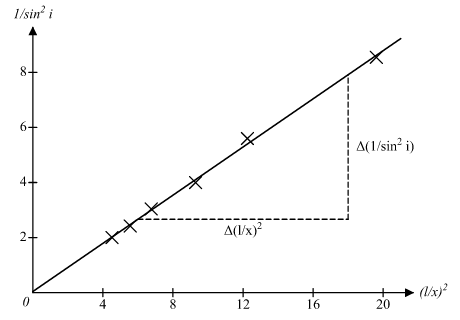
What we are solvingA ray is traced through a rectangular glass block with optical pinsThe constant γ is found twice: from one ray (Method I) and from a graph of six rays (Method II)Then both are compared with γ=0.667Chapter: Optics (practical)Topic: refraction through a rectangular glass blockConcept and formulasSnell's law at a face: sin(angle in air)=nsin(angle in glass), n = refractive index of glassA rectangular block has parallel faces, so the ray leaves parallel to the incident rayMethod I: at G, angle in glass ϕ, angle in air θ, so sinθ=nsinϕIn triangle GJK: JK=d, GJ=y, so d=ytanθγ1=dcosθysinϕ=ytanθcosθysinϕ=sinθsinϕ=n1Method II: block thickness t, refraction angle r inside, ray ED of length lx=lsinr (sideways shift of D from the normal at E), so sinr=lxsini=nsinr=nlx⇒sin2i1=n21(xl)2So the graph is a straight line through the origin with slope S=n21 and γ2=S=n1γ is the reciprocal of the refractive index of glass (1/1.5=0.667)WorkingSample readings (your own readings will differ)METHOD I(a) to (e) Trace ABCD, mark O 4.0 cm from A, draw the normal at O and draw QO at α=40∘ to AB (angle of incidence =90∘−40∘=50∘)(f) Draw EF 15.0 cm long, parallel to DC and 5.0 cm from it(g) to (i) Fix P1, P2 on QO well apart; replace the block; looking through face DC, fix P3, P4 in line with the images of P1, P2(j) to (m) Remove block and pins; draw P3P4 to meet DC at G and EF at K; join GO; draw the normal NS at G(n) Readings: ϕ=31∘, θ=50∘, d=JK=6.0 cm(o)γ1=dcosθysinϕ=6.0×cos50∘5.0×sin31∘=6.0×0.64285.0×0.5150=3.8572.575=0.668METHOD II(a) to (f) Trace XYZW; mark E,F,G,H,I,J at 1.5, 3.0, 4.5, 6.0, 7.5, 9.0 cm from X; draw a normal at each; draw the incident lines at i=45∘,40∘,35∘,30∘,25∘,20∘(g) to (l) For each line, fix two pins on it, replace the block, fix P3, P4 from side ZW, remove the block, draw P3P4 to meet ZW at D and join DE(m), (n) Measure l (length of the ray inside the block) and x (distance of D from the foot of that normal on ZW)(o) Table of results:
i (°)
sini
sin2i1
x (cm)
l (cm)
l/x
(l/x)2
45
0.7071
2.000
3.2
6.8
2.125
4.52
40
0.6428
2.420
2.8
6.6
2.357
5.56
35
0.5736
3.040
2.5
6.5
2.600
6.76
30
0.5000
4.000
2.1
6.4
3.048
9.29
25
0.4226
5.599
1.8
6.3
3.500
12.25
20
0.3420
8.549
1.4
6.2
4.429
19.61
(p) Plot sin2i1 against (xl)2; a straight line close to the origin:
(q) Slope from a large triangle, from (l/x)2=6.0 to 18.0:S=18.0−6.07.92−2.67=12.05.25=0.438(r)γ2=S=0.438=0.662(s) Percentage error of each method against 0.667:Method I: 0.667∣0.668−0.667∣×100%=0.15%Method II: 0.667∣0.662−0.667∣×100%=0.75%ConclusionBoth methods are accurate: each value is within 1% of 0.667With these readings Method I came closer, but it rests on a single ray, so one misplaced pin changes it a lotMethod II uses six rays and a best-fit line, which averages out random errors; it is the more reliable methodAnswer: (sample readings) γ1≈0.668, γ2≈0.662; both accurate (within 1%), Method II more reliableTip: Keep the pins at least 4 cm apart and look at the bottoms of the pins, to reduce errors in the ray direction