What we are solvingThe constant
ρ of the bare wire
W is its resistance per metre (
Ω m−1)
Method I: voltmeter and ammeter readings for two lengths
x give
ρ1Method II: a potentiometer and a graph give
ρ2Then compare with 4.41 and average
Chapter: Current electricity (practical)
Topic: resistance of a wire, potentiometer
Concept and formulasResistance of a length
L of uniform wire:
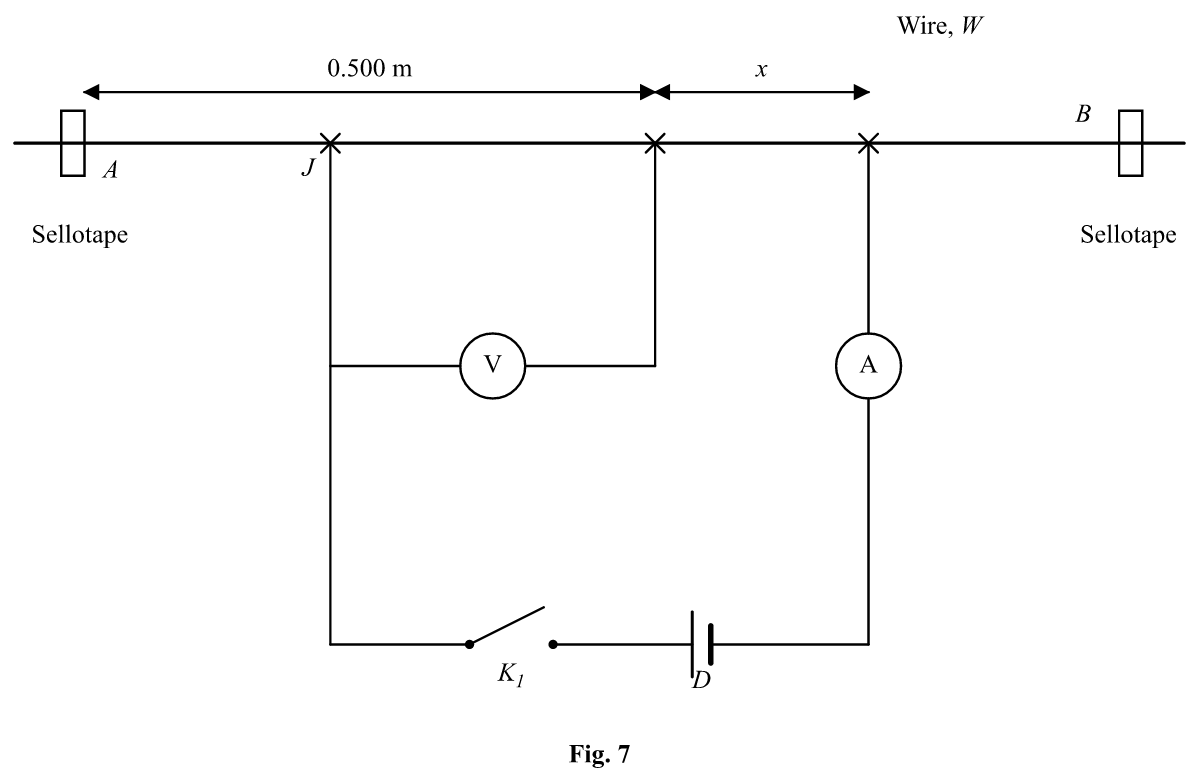
R=ρLMethod I (Figure 7): the current
I flows from the clip, through length
x, then through the length
JP to
JThe voltmeter is across
JP only:
V=Iρ(JP)Cell
D (e.m.f.
E=1.5 V) drives the current through the wire and through
R (cell, ammeter and leads):
E=V+Iρx+IR ⇒ IE−V=ρx+RTwo readings (
x1,I1,V1) and (
x2,I2,V2) remove the unknown
R:
I1E−V1−I2E−V2=ρ(x1−x2)Multiply by
I1I2 and rearrange, with
E=1.5 V:
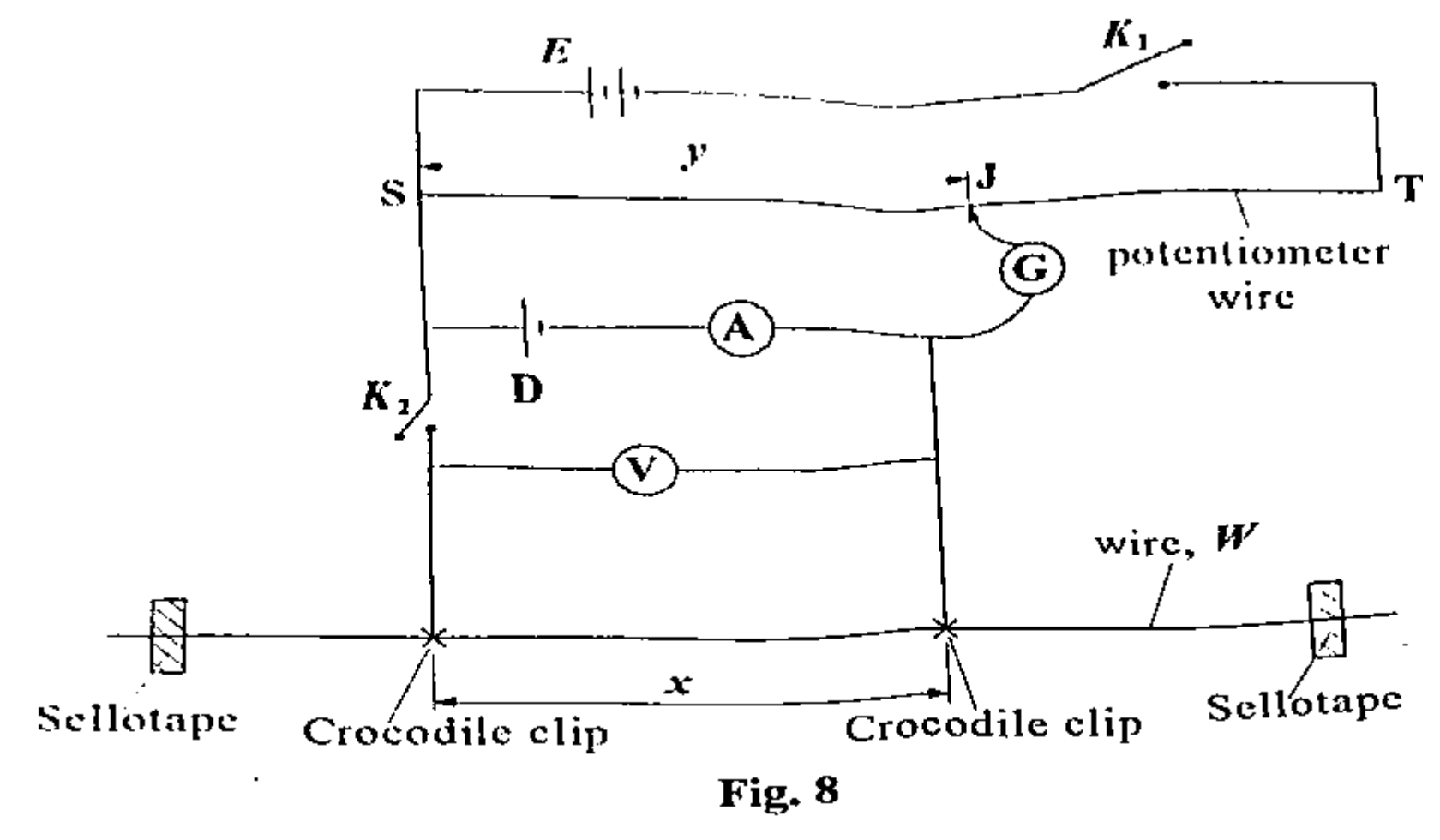
ρ1=I1I2(x2−x1)1[(V1I2−V2I1)−1.5(I2−I1)]Method II (Figure 8): at balance the potentiometer and the voltmeter both measure the p.d. across length
x of
WV=ky(k=potential gradient of ST),V=IρxDividing by
y:
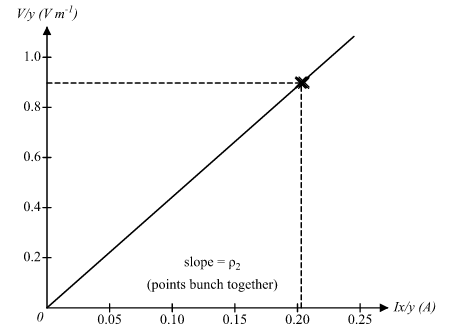
yV=ρyIx, a line through the origin with slope
ρ2WorkingSample readings (your own readings will differ)
METHOD I(a) Connect the circuit of Figure 7, with the wire taped flat on the bench
(b) to (e) x1=0.250 m; close
K1; slide
J until
I1=0.26 A; voltmeter:
V1=0.30 V
(f) Open
K1 between readings so the wire does not heat up
(g), (h) x2=0.500 m,
I2=0.20 A; voltmeter:
V2=0.36 V
(i)V1I2−V2I1=0.30×0.20−0.36×0.26=0.0600−0.0936=−0.0336−1.5(I2−I1)=−1.5(0.20−0.26)=+0.0900I1I2(x2−x1)=0.26×0.20×0.250=0.0130ρ1=0.0130−0.0336+0.0900=0.01300.0564=4.34 Ω m−1METHOD II(a), (b) Connect Figure 8; close
K2 with
K1 open
(c) to (g) Set
x=0.200 m; close
K1; slide
J along
ST until
G shows no deflection; read
y,
V and
I; open both switches
(h), (i) Repeat for the other lengths and tabulate:
| x (m) | y (m) | V (V) | I (A) | V/y (V m−1) | Ix/y (A) |
|---|
| 0.200 | 0.435 | 0.39 | 0.44 | 0.897 | 0.202 |
| 0.300 | 0.577 | 0.52 | 0.39 | 0.901 | 0.203 |
| 0.400 | 0.689 | 0.62 | 0.35 | 0.900 | 0.203 |
| 0.500 | 0.781 | 0.70 | 0.32 | 0.896 | 0.205 |
| 0.600 | 0.857 | 0.77 | 0.29 | 0.898 | 0.203 |
| 0.700 | 0.921 | 0.83 | 0.27 | 0.901 | 0.205 |
(j) Plot
V/y against
Ix/y and draw the best line through the origin:
Since
V and
ky are the same p.d.,
V/y stays almost constant and the points bunch together; the line through the origin fixes the slope
(k)ρ2=slope=0.2030.898=4.42 Ω m−1(l) Compare with 4.41:
Method I: 4.41∣4.34−4.41∣×100%=1.6%Method II: 4.41∣4.42−4.41∣×100%=0.2%(m)2ρ=ρ1+ρ2=4.34+4.42=8.76 ⇒ ρ=4.38 Ω m−1(n) Averaging the two values reduces the effect of random errors in each method
The mean is a more reliable value of
ρ than either result alone
ConclusionBoth methods are suitable: each value is within 2% of 4.41
Method II is more suitable: the potentiometer is a null method (no current drawn at balance) and it uses six readings and a graph
Method I uses only two readings and assumes the cell e.m.f. is exactly 1.5 V, so it is less accurate
Answer: (sample readings)
ρ1≈4.34 Ω m−1,
ρ2≈4.42 Ω m−1,
ρ≈4.38 Ω m−1Tip: Before taking a potentiometer reading, check that
J gives deflections in opposite directions at the two ends of
ST