What we are solvingDefinitions of gravitational field strength and parking orbitShow that the escape speed from the earth is V=2grDifferences between free and damped oscillationsAn experiment for g with a helical springA 100kg satellite at 3.2×10⁶m above the surface: its period and kinetic energyChapter: MechanicsTopic: Gravitation, satellites and simple harmonic motion(a)(i)(1 mark)Gravitational field strength at a point is the force exerted on a mass of 1 kg placed at that pointg=mF, unit N kg−1(a)(ii)(1 mark)A parking orbit is the orbit of a satellite whose period equals the period of the earth's rotation (24 hours)The satellite moves in the equatorial plane in the same direction as the earth rotates, so it stays above the same point(b)(3 marks)To escape, the rocket's kinetic energy must at least equal the work needed to take it from the surface to infinity21mV2=rGMmV=r2GMAt the surface the weight equals the gravitational pullmg=r2GMm⇒GM=gr2V=r2gr2=2gr(c)(3 marks)Free oscillations: amplitude stays constant; damped: amplitude decreases with timeFree: no energy is lost; damped: energy is lost to the surroundings (as heat) by resistive forcesFree: no resistive force acts; damped: a resistive (frictional, viscous) force opposes the motion(Free oscillations take place at the natural frequency; damping makes the period slightly longer)(d)(6 marks)
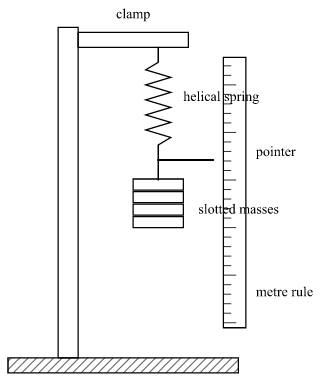
Clamp the helical spring vertically with a pointer and a hanger at its lower end, beside a vertical metre ruleNote the pointer reading l0 with no slotted massAdd a slotted mass m; note the new reading l; the extension is e=l−l0Pull the mass down slightly and release it so it oscillates verticallyTime 20 oscillations with the stop clock; period T=t/20Repeat for several masses and tabulate e, T and T2Theory: at equilibrium ke=mg, and the period isT=2πkm=2πge⇒T2=g4π2ePlot T2 against e: a straight line through the origin with slope sg=s4π2(e)(i)(3 marks)Gravity provides the centripetal forcer2GMm=m(T2π)2r⇒T=2πGMr3Orbit radius from the earth's centrer=6.4×10⁶+3.2×106=9.6×10⁶mGM=6.67×10−11×5.97×1024=3.98×10¹⁴N m2kg−1T=2π3.98×10¹⁴(9.6×10⁶)3=2π2.22×10⁶T=2π×1491=9.37×10³s(≈2.6h)(e)(ii)(3 marks)rmv2=r2GMm⇒21mv2=2rGMmK.E.=2×9.6×1063.98×1014×100=2.07×10⁹JAnswer: (b) V=2gr; (e) T≈9.37×10³s, K.E. ≈2.07×10⁹JTip: The height is measured from the surface: add the earth's radius before using r