What we are solvingStatic and dynamic pressure, and how Pitot-static tubes give the speed of flowing waterBernoulli's principle and the Bunsen burnerSpeed of water from a hole 20cm below the surface of a large tankArchimedes' principle, and an alloy of iron and aluminium (588g, 100cm3)Chapter: Mechanics of fluidsTopic: Fluid flow, Bernoulli's principle and Archimedes' principle(a)(i)(2 marks)Static pressure is the pressure of a fluid that is not due to its motion; it acts on a surface parallel to the flowDynamic pressure is the pressure due to the motion of the fluid, equal to 21ρv2(a)(ii)(5 marks)
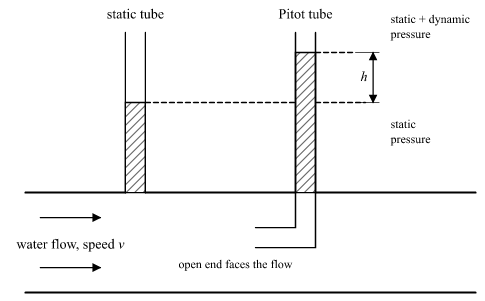
A static tube is fixed with its opening flush with (parallel to) the flow; water rises in it to a height that measures the static pressure PA Pitot tube is bent so that its open end faces the flow; water entering it is brought to restSo the Pitot tube measures the total pressure P+21ρv2 and its water level is higherMeasure the difference h between the two water levels with a metre rule(P+21ρv2)−P=ρghv=2gh(a)(iii)(1 mark)The flow is steady (streamline) and non-viscous, and water is incompressible(b)(i)(1 mark)For steady streamline flow of a non-viscous, incompressible fluid, the sum of the pressure, the kinetic energy per unit volume and the potential energy per unit volume is constant at every pointP+21ρv2+ρgh=constant(b)(ii)(3 marks)Gas leaves the narrow jet at the base at a high speedBy Bernoulli's principle the pressure around the fast jet falls below atmospheric pressureSo air is drawn in through the air holes; gas cannot flow out of themThe gas-air mixture moves up the barrel, slows down at the wider top where pressure is atmospheric, and burns there(b)(iii)(3 marks)The tank is large, so the water surface moves very slowlyBernoulli between the surface and the hole (both at atmospheric pressure) gives Torricelli's result, with h the depth of the hole below the surfacev=2ghv=2×9.81×0.20=3.924=1.98m s−1(The total depth of 1.0m is not needed)(c)(i)(1 mark)When a body is wholly or partially immersed in a fluid, it experiences an upthrust equal to the weight of the fluid displaced(c)(ii)(4 marks)Densities: iron 8.0g cm−3, aluminium 2.7g cm−3Let the volumes be Vi and Va (in cm3)Vi+Va=1008.0Vi+2.7Va=5888.0Vi+2.7(100−Vi)=5885.3Vi=318⇒Vi=60cm3,Va=40cm3Proportion by volume, iron : aluminium = 60 : 40 = 3 : 2Answer: (b)(iii) 1.98m s−1; (c)(ii) iron : aluminium = 3 : 2 by volume (60% iron)Tip: Check: 60×8.0+40×2.7=480+108=588g