What we are solvingElastic materials, the energy stored in a stretched material and the energy changes
Young's modulus experiment with two identical wires
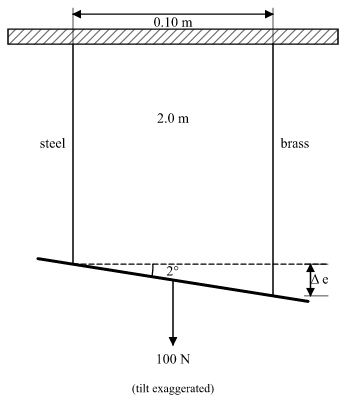
A light bar hung from a steel wire and a brass wire (
2.0 m long,
0.80 mm diameter,
0.10 m apart) tilts by
2∘ under
100 N at its centre
We need the difference in extensions and the extension of the brass wire
Chapter: Mechanical properties of matter
Topic: Elasticity and Young's modulus
(a)(i) (1 mark)An elastic material is one that regains its original shape and size when the deforming force is removed
(a)(ii) (4 marks)Within the elastic limit the stretching force at extension
x is
F=kxWork done in a further small extension
dx:
dW=Fdx=kxdxTotal work done from extension
e1 to
e2 is stored as energy
E=∫e1e2kxdx=[21kx2]e1e2E=21k(e22−e12)(It is the area under the force-extension line between
e1 and
e2)
(a)(iii) (3 marks)Work done by the stretching force is stored as elastic potential energy of the molecules (they are pulled apart from their equilibrium positions)
When the force is removed, this potential energy changes to kinetic energy as the molecules return to their equilibrium positions
Part of the energy is changed into heat (internal energy) because of internal friction between the molecules
(b)(i) (2 marks)Original length
l of the wire (metre rule)
Diameter
d at several points (micrometer screw gauge), to get the area
A=πd2/4Extension
e for each load
mg (vernier scale between the two wires)
(b)(ii) (2 marks)The reference wire carries the main scale and the test wire carries the vernier
Any change in temperature (expansion) or sagging of the support affects both wires equally, so the vernier reads only the extension due to the load
(c)(i) (2 marks)The bar ends are
0.10 m apart; the brass end drops further, so
Δe=0.10tan2∘=0.10×0.0349=3.49×10⁻³ m(c)(ii) (6 marks)The bar is light and the load is at its centre; moments about the centre give equal tensions
Ts=Tb=2100=50 NYoung's modulus gives the steel extension
E=AeTl ⇒ es=AEsTlA=4πd2=4π(0.80×10⁻³)2=5.03×10⁻⁷ m2es=5.03×10−7×2.0×101150×2.0=9.95×10⁻⁴ mThe brass wire stretches more by
Δeeb=es+Δe=9.95×10⁻⁴+3.49×10−3=4.49×10⁻³ mAnswer: (c)(i)
3.49×10⁻³ m; (c)(ii)
4.49×10⁻³ m (about
4.5 mm)
Tip: Use the radius, not the diameter, in
πr2 (or
πd2/4)