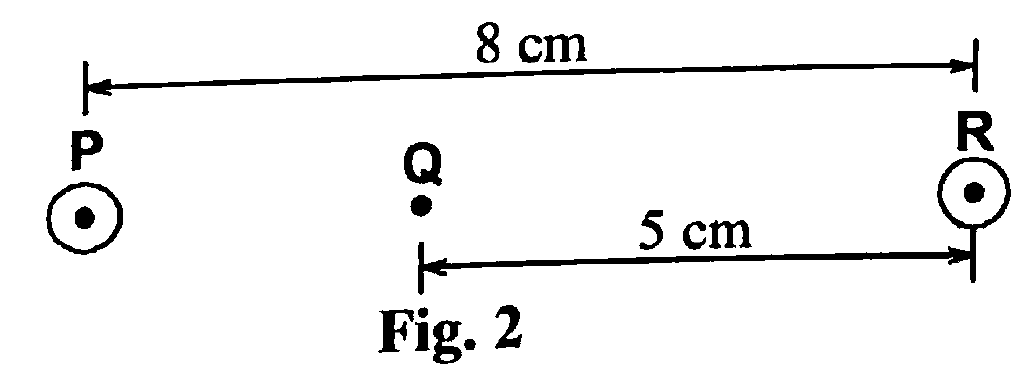
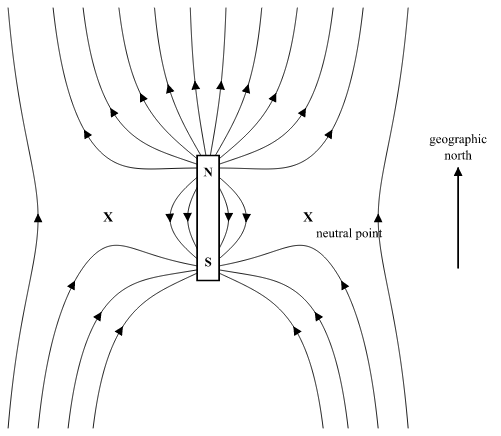
What we are solvingMagnetic definitions, a field pattern, the earth inductor, the current balance and the field of two wiresGiven for (d): wires P and R 8 cm apart with 9 A and 5 A out of the paper; Q is 5 cm from R (so 3 cm from P)Chapter: Magnetic effect of an electric currentTopic: Magnetic fields, forces on conductors and the galvanometer(a)(i)(1 mark)A magnetic field is a region (space) in which a magnetic material, a moving charge or a current-carrying conductor experiences a magnetic force(a)(ii)(1 mark)Magnetic saturation is the state in which all the magnetic domains of a material are aligned with the magnetising field, so a stronger field produces no further magnetisation(b)(i)(1 mark)The earth's field points to geographic north; the magnet's field beside its middle points from N to S (southwards)So the two fields cancel at two neutral points X on the east-west line through the middle of the magnet
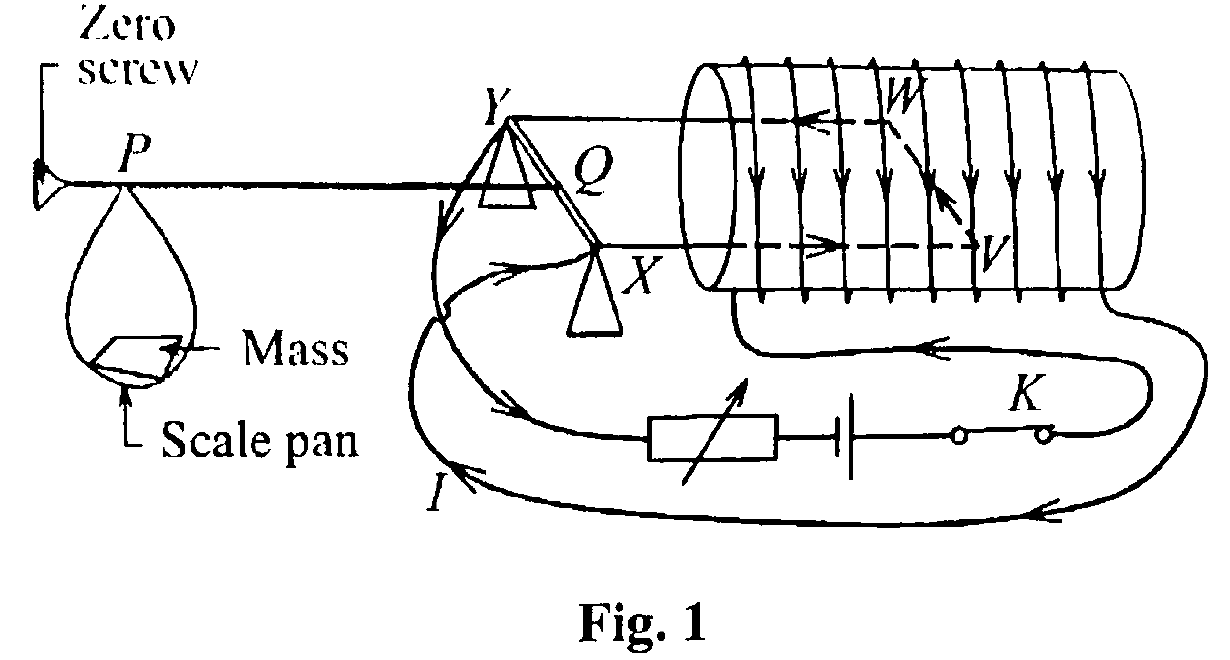
(b)(ii)(4 marks)An earth inductor is a large coil of N turns and area A that can be turned quickly through 180∘; it is connected to a ballistic galvanometerPlace the coil with its plane horizontal and turn it quickly through 180∘ about a horizontal axis; the flux change is 2NABV; record the throw θ1Place the coil with its plane vertical, perpendicular to the magnetic meridian, and turn it through 180∘ about a vertical axis; the flux change is 2NABH; record the throw θ2The charge (and the throw) is proportional to the flux change, so θ2θ1=BHBVtanδ=BHBV=θ2θ1(c)(i)(1 mark)The ampere is the constant current which, flowing in two straight, parallel, infinitely long conductors of negligible cross-section placed 1 m apart in a vacuum, produces between them a force of 2×10⁻⁷ N per metre of length(c)(ii)(3 marks)The same current I flows in the solenoid and in the frame (series circuit)Flux density inside the solenoid: B=μ0nIForce on side VW (length l), perpendicular to B: F=BIl=μ0nI2lSides XV and WY give no turning effect about the axis XYTaking moments about XY at balance, with PQ=YW:mg×PQ=μ0nI2l×YWmg=μ0nI2l⇒I=μ0nlmg(d)(i)(4 marks)Field of a long straight wire: B=2πrμ0IDue to P (9 A, r=0.03 m): BP=2π×0.034π×10−7×9=6.0×10⁻⁵TDue to R (5 A, r=0.05 m): BR=2π×0.054π×10−7×5=2.0×10⁻⁵TBoth currents come out of the paper, so their fields are anticlockwise; at Q (between them) the two fields point in opposite directions (right-hand grip rule)BQ=6.0×10⁻⁵−2.0×10−5=4.0×10⁻⁵TDirection: that of BP, perpendicular to PR (towards the top of the page in Fig. 2)(d)(ii)(3 marks)lF=2πdμ0I1I2lF=2π×0.084π×10−7×9×5lF=1.125×10⁻⁴N m−1The currents are in the same direction, so the force on P is attractive, towards R(e)(2 marks)Current sensitivity Iθ=kBAN, so it depends on:1. the number of turns N of the coil2. the area A of the coil3. the magnetic flux density B of the radial field4. the torsion constant k of the suspension (hair-springs)Answer: (d)(i) 4.0 × 10⁻⁵ T at Q; (d)(ii) 1.13 × 10⁻⁴ N/m, attraction towards RTip: Between two like currents the fields subtract; between unlike currents they add