What we are solvinga.c. definitions, power in a capacitor, an RC series calculation, phase graphs and the repulsion-type meterGiven for (c): C=20μF in series with R=100Ω, f=30 Hz, peak voltage 60 VChapter: Alternating currentsTopic: r.m.s. values, reactance, impedance and a.c. meters(a)(i)(1 mark)The r.m.s. value of an alternating current is the value of the steady (direct) current which dissipates heat in a given resistor at the same rate as the alternating current(a)(ii)(1 mark)Reactance is the opposition to the flow of alternating current offered by a capacitor or an inductor, without dissipating energy (X=Vrms/Irms)(a)(iii)(1 mark)Impedance is the total opposition of a circuit containing resistance and reactance to an alternating current (Z=Vrms/Irms)(b)(3 marks)V=V0sinωt,Q=CVI=dtdQ=ωCV0cosωt=I0cosωtP=VI=V0I0sinωtcosωt=21V0I0sin2ωtOver one complete cycle the average of sin2ωt is zero⟨P⟩=0Energy stored in the capacitor in one quarter cycle is returned to the source in the next(c)(5 marks)XC=2πfC1=2π×30×20×10−61=265.3ΩZ=R2+XC2=1002+265.32=283.5ΩVrms=2V0=260=42.4VIrms=ZVrms=283.542.4=0.150A(d)(i)(2 marks)
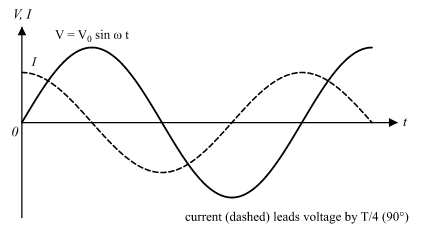
The current is a cosine curve: it leads the voltage by a quarter of a period (90∘)(d)(ii)(2 marks)When V=V0 the capacitor is fully charged and V is momentarily not changing, so I=dtdQ=CdtdV=0When V=0 the voltage is changing fastest, so the charging current is maximum, I=±I0(e)(5 marks)The meter has a coil carrying the current to be measured; inside it are two soft-iron rods, one fixed and one attached to the pivoted pointerThe current magnetises both rods in the same direction, so like poles lie side by sideThe rods repel each other and the movable rod turns the pointerThe pointer stops when the restoring torque of the hair-spring equals the deflecting torqueThe force depends on the product of the two magnetisations, so the deflection is roughly proportional to I2 (non-uniform scale)When the current reverses, both rods reverse their polarity together, so they still repel: the meter reads a.c. (r.m.s.) as well as d.c.Answer: (c) I(rms) = 0.150 A; (d) I = 0 when V = V₀, I is maximum when V = 0Tip: Use the r.m.s. voltage, not the peak voltage, when finding the r.m.s. current