What we are solvingElectric field and flux, the field of a charged plane conductor, the oil drop, shielding, induction and point action
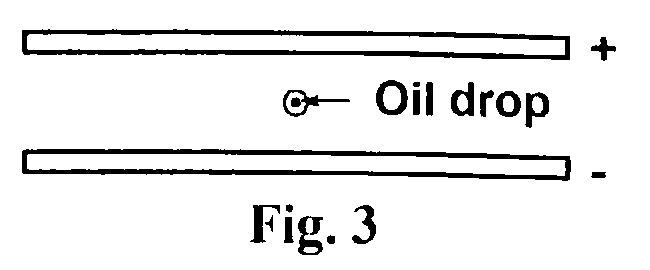
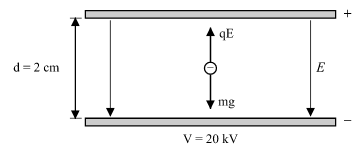
Given for (c)(i): plates 2 cm apart, p.d. 20 kV, oil drop of mass
5.9×10⁻¹⁴ kg at rest
Chapter: Electrostatics
Topic: Electric fields, charge distribution and point action
(a)(i) (1 mark)An electric field is a region (space) in which an electric charge experiences an electric force
(a)(ii) (1 mark)Electric flux through a surface is the product of the electric field intensity and the area perpendicular to the field,
ϕ=EAcosθ (the number of field lines passing through the surface)
(b) (3 marks)Let the conductor carry surface charge density
σ; draw a small cylinder (Gaussian surface) of end area A with one end inside the conductor and one end outside, at any distance
Inside a conductor E = 0, and no flux passes through the curved side (E is normal to the surface)
By Gauss's law, flux = enclosed charge /
ε0:
EA=ε0σA ⇒ E=ε0σThis does not contain the distance, so the field intensity is independent of the distance from the plane conductor
(c)(i) (4 marks)E=dV=0.0220×103=1.0×10⁶ V m−1The drop is at rest, so the electric force balances the weight:
qE=mg ⇒ q=Emg=1.0×1065.9×10−14×9.81q=5.79×10⁻¹⁹ Cn=eq=1.6×10−195.79×10−19=3.6≈4The oil drop carries about 4 excess electrons
Key point: Charge comes in whole electrons; the printed data give 3.6, so the estimate is the nearest whole number, 4
(c)(ii) (3 marks)Enclose the material in a hollow metal (conducting) box, a Faraday cage
The free electrons in the box move under the field until the induced charges on its surfaces cancel the field inside
So the field inside the hollow conductor is zero and the material is shielded
(d) (4 marks)The negative charge induces positive charge on the near side of the neutral conductor and negative charge on the far side
If the conductor is earthed (or large), the far-side negative charge flows away, leaving positive charge near the material
The positive induced charge makes a positive potential at the material, which raises its negative potential towards zero
So the magnitude of the potential of the material falls; since
C=Q/V, its capacitance increases and it can hold more charge
(e) (4 marks)Charge density is greatest where the curvature is greatest, so it is very large at the sharp point of the pin
The electric field near the point is so strong that it ionises the surrounding air molecules
Ions of opposite sign are attracted to the point and neutralise its charge; ions of the same sign are repelled, forming an electric wind
So the conductor loses its charge much faster (point action / corona discharge)
Answer: (b) E = σ/ε₀; (c)(i) q = 5.79 × 10⁻¹⁹ C, about 4 electrons
Tip: For a drop held at rest, write qE = mg first