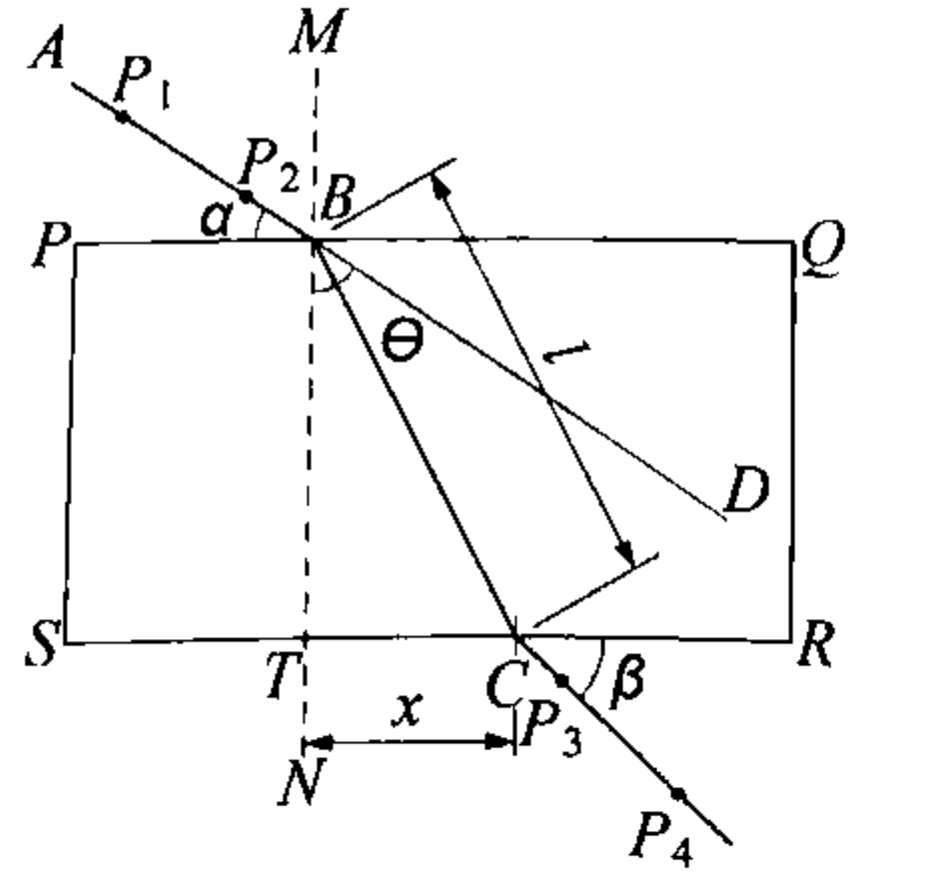
What we are solvingA ray strikes face PQ of a glass block at B, making angle α with the face; it refracts along BC and leaves at CPart I: measure β and l=BC for six values of α; plot l21 against cos2β; find γ from the intercept and λ1 from intercept and slopePart II: measure θ, x and l for α=20∘ and find λ2; average λ1 and λ2Chapter: Light (refraction at plane surfaces)Topic: refractive index of glass by the rectangular blockConcept and formulasAngle of incidence at B: i=90∘−α; angle of refraction r = angle between BC and the normal BNSnell's law: n=sinrsiniFor parallel faces the emergent ray is parallel to the incident ray, so β=α and cosβ=siniLet t = width of the block (PS). In triangle BTC: l=BC=cosrt and x=TC=ttanr, so lx=sinrl21=t2cos2r=t21−sin2r=t21−n2t2sin2il21=t21−n2t21cos2βStraight line: intercept C=t21, slope S=−n2t21So γ=C1=t (the width of the block) and λ1=S−C=n (the refractive index)In Part II, θ is the angle between the normal BN and BD (the incident ray produced), so θ=i and λ2=x/lsinθ=sinrsini=nWorkingSample readings (your own readings will differ); block width t=6.0 cmPART I(a)–(f) Pin the paper down, trace the block PQRS, draw the normal MN at B (PB=2.0 cm) and draw AB at α=20∘ to PQ with a protractor(g)–(i) Replace the block; fix P1, P2 upright on AB, well apart; looking through face SR, fix P3, P4 in line with the images of P1, P2 (sight the bases of the pins)(j)–(m) Remove block and pins; draw P4P3 to meet SR at C; join BC; measure β with the protractor and l=BC with a ruler(n)–(o) Repeat for α=30∘,40∘,50∘,60∘,70∘ and tabulate
α / ∘
β / ∘
l / cm
cos2β
l21 / cm−2
20
20
7.70
0.883
0.0169
30
30
7.35
0.750
0.0185
40
40
6.98
0.587
0.0205
50
50
6.64
0.413
0.0227
60
60
6.36
0.250
0.0247
70
70
6.16
0.117
0.0264
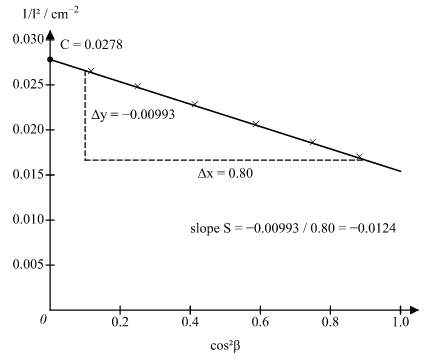
(p) Plot l21 (vertical) against cos2β (horizontal), starting the cos2β axis at 0 so the intercept can be read
(q) Intercept on the l21-axis: C=0.0278 cm−2(r)γ=C1=0.02781=36.0=6.0cm(this equals the width PS of the block, a quick check)(s) Slope from two points on the line:S=0.90−0.100.01665−0.02658=0.80−0.00993=−0.0124cm−2(t)λ1=S−C=−0.0124−0.0278=2.24=1.50PART II(a)–(c) On the diagram for α=20∘, produce AB to D inside the block; measure θ (between BN and BD), x=TC and l=BCSample: θ=70∘, x=4.82 cm, l=7.70 cm(d)λ2=x/lsinθ=4.82/7.70sin70∘=0.62600.9397=1.50(e)λ=2λ1+λ2=21.50+1.50=1.50λ is the refractive index of the glass (no unit); ordinary glass gives about 1.5(f) Sources of error (any two)1. Pins not exactly vertical or not exactly in line with the images2. Pins placed too close together, so the direction of the ray is poorly fixed3. Error in drawing the outline (pencil slanting under the block, block moved when pins were fixed)4. Errors in reading the protractor for small angles α and βAnswer:C≈0.0278 cm−2, γ≈6.0 cm (width of the block); S≈−0.0124 cm−2; λ1≈λ2≈λ≈1.5 (refractive index), sample readingsTip: Check that β comes out equal to α: if it does not, the pins or the outline are off