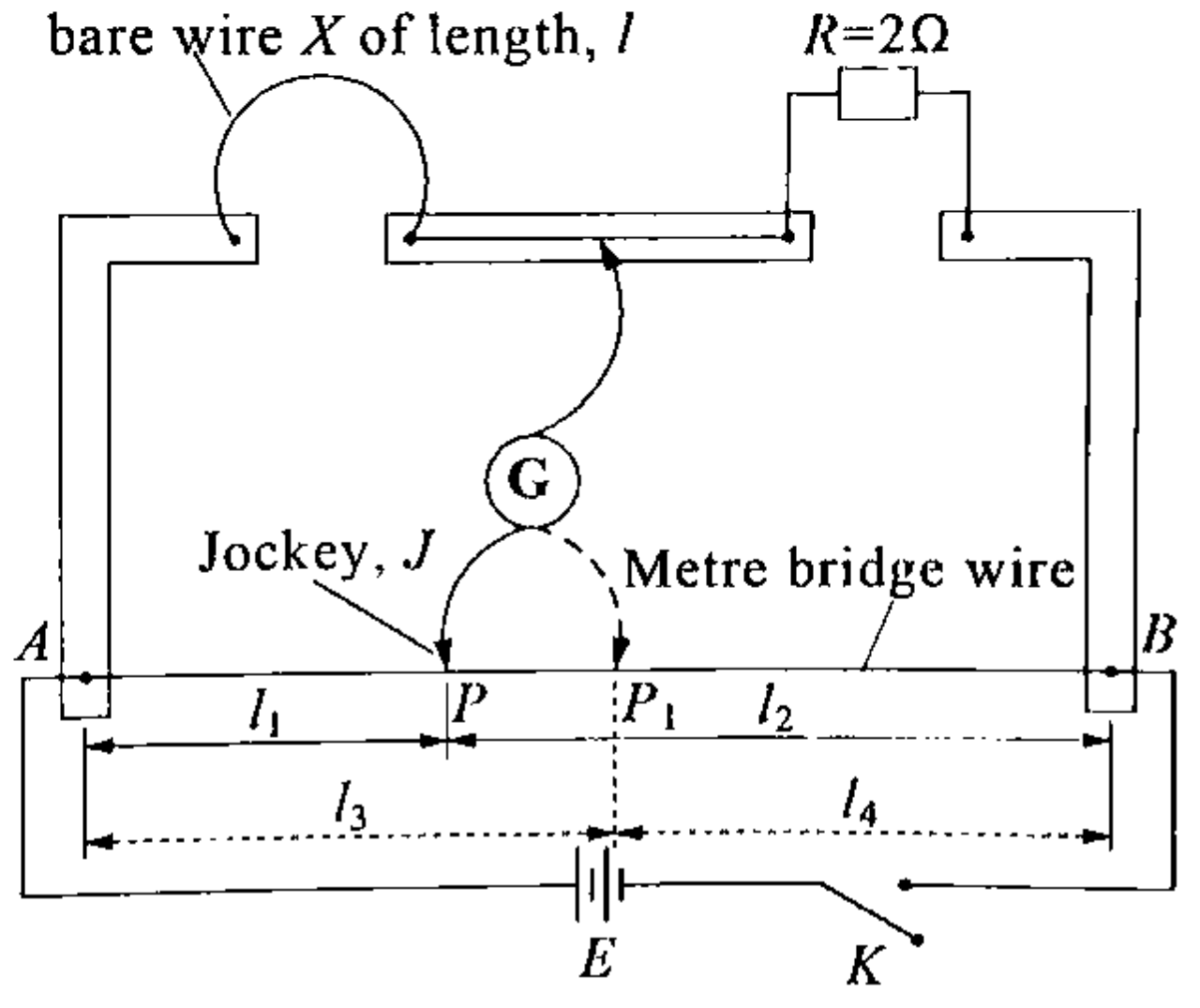
What we are solvingA metre bridge compares each bare wire (left gap) with a standard resistor
R=2 Ω (right gap)
For lengths
l=0.200 to
0.700 m of wire
X and then wire
Y, find the balance lengths
Compute
Zx=l22l1 and
Zy=l42l3, plot
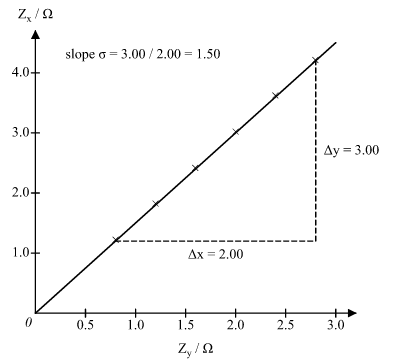
Zx against
Zy and find the slope
σChapter: Current electricity
Topic: Wheatstone bridge principle; the metre bridge; resistivity
Concept and formulasAt balance the galvanometer shows no deflection and the bridge ratio holds:
RRX=l2l1 ⇒ RX=Rl2l1=l22l1=ZxIn the same way
RY=l42l3=Zy; so
Zx and
Zy are the resistances (in
Ω) of equal lengths of
X and
YResistance of a uniform wire:
R=Aρrl (
ρr resistivity,
A cross-section area)
ZyZx=ρY/AYρX/AX=constantSo
Zx against
Zy is a straight line through the origin; its slope
σ is the ratio of the resistance per metre of
X to that of
Y (no unit)
WorkingSample readings (your own readings will differ)
(a)–(c) Connect
R=2 Ω in the right-hand gap and
X in the left-hand gap; cells
E and switch
K across
AB; galvanometer from the centre terminal to the jockey; tighten every terminal
(d)–(h) With
l=0.200 m of
X between the terminals, close
K, tap the jockey along
AB (do not slide it) until
G shows no deflection; read
l1=AP and
l2=PB=1.000−l1; open
K between readings so the wire does not heat
(i) Repeat for
l=0.300,0.400,0.500,0.600,0.700 m
(j)–(p) Replace
X with
Y and repeat, giving
l3=AP1 and
l4=P1B(q) Table of results
| l / m | l1 / m | l2 / m | l3 / m | l4 / m | Zx=l22l1 / Ω | Zy=l42l3 / Ω |
|---|
| 0.200 | 0.375 | 0.625 | 0.286 | 0.714 | 1.200 | 0.801 |
| 0.300 | 0.474 | 0.526 | 0.375 | 0.625 | 1.802 | 1.200 |
| 0.400 | 0.545 | 0.455 | 0.444 | 0.556 | 2.396 | 1.597 |
| 0.500 | 0.600 | 0.400 | 0.500 | 0.500 | 3.000 | 2.000 |
| 0.600 | 0.643 | 0.357 | 0.545 | 0.455 | 3.602 | 2.396 |
| 0.700 | 0.677 | 0.323 | 0.583 | 0.417 | 4.192 | 2.796 |
Example of one row (
l=0.200 m):
Zx=0.6252×0.375=1.200 Ω,
Zy=0.7142×0.286=0.801 Ω(r) Plot
Zx (vertical) against
Zy (horizontal): a straight line through the origin
(s) Slope from two points on the line:
σ=ΔZyΔZx=2.80−0.804.20−1.20=2.003.00=1.50So wire
X has 1.5 times the resistance per metre of wire
Y(t) Sources of error (any two)
1. End (contact) resistance at the terminals and at the ends of the bridge wire
2. The bridge wire is not perfectly uniform
3. Heating of the wires when the current flows too long (switch not opened between readings)
4. Error in setting the length
l of the bare wire between the terminals, or kinks in the wire
5. Sliding the jockey scrapes the wire and changes its cross-section
Answer: Zx and
Zy are the resistances of equal lengths of
X and
Y; the graph is a straight line through the origin with slope
σ≈1.5 (sample readings)
Tip: Choose
R so the balance point falls near the middle of the wire (30–70 cm): this reduces the effect of end errors