What we are solvingSurface tension: two definitions, the excess pressure in a soap bubble, the pressure in an air bubble under water,
the mercury height that pressure supports, the radius of the common interface of two joined bubbles,
and the pressure
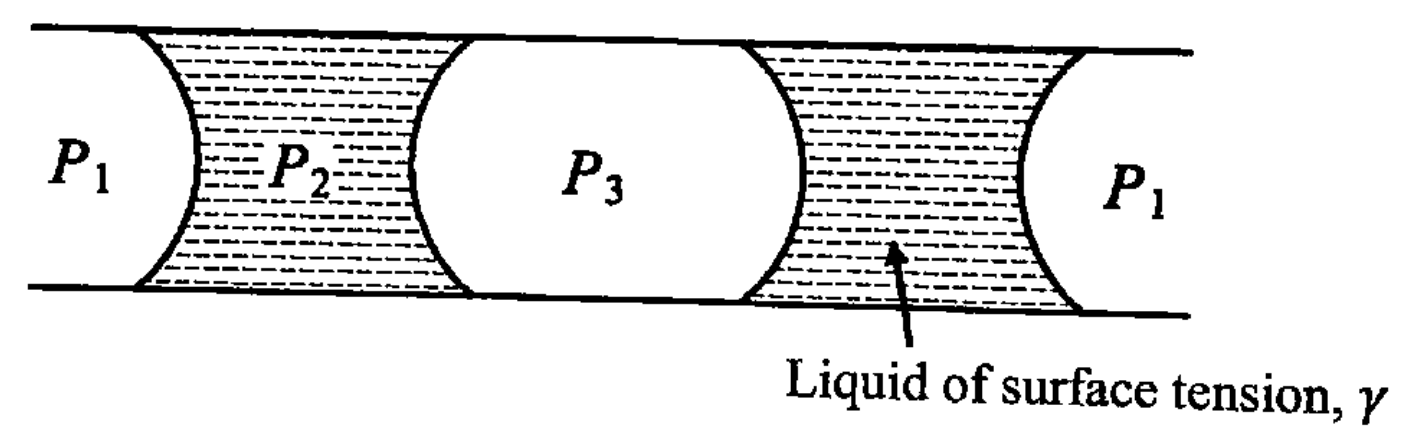
P3 trapped between two liquid plugs in a capillary tube (Fig. 1)
Chapter: Mechanical properties of matter
Topic: surface tension, excess pressure in drops and bubbles
Concept and formulasExcess pressure inside a curved surface of radius
r:
Δp=r2γ for one surface (air bubble in a liquid, liquid drop)
A soap bubble has two surfaces (inner and outer film), so
Δp=r4γPressure at depth
h in a liquid:
p=P0+hρgThe pressure is always greater on the concave side of a curved surface
γ = surface tension (
N m−1),
r = radius (m),
ρ = density (
kg m−3)
(a)(i) (1 mark)Surface tension is the force per unit length acting in the surface of a liquid at right angles to one side of an imaginary line drawn in the surface
(a)(ii) (1 mark)Surface tension is the work done (energy needed) to increase the surface area of a liquid by
1 m2 at constant temperature
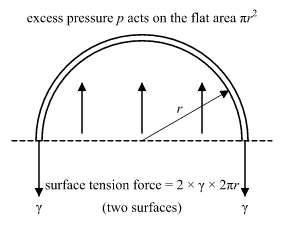
(b)(i) (4 marks)Consider the upper half of a soap bubble of radius
r, with inside pressure
p and outside pressure
P0 (see the figure)
The excess pressure
(p−P0) acts on the flat circular face of area
πr2, pushing the upper half up:
Fup=(p−P0)πr2Surface tension acts along the rim of length
2πr, on
two surfaces, pulling the upper half down:
Fdown=γ×2πr×2=4πrγFor equilibrium the two forces are equal:
(p−P0)πr2=4πrγp−P0=r4γ(b)(ii) (3 marks)An air bubble inside water has only one surface, so the excess pressure is
r2γr2γ=1.0×10−52×7.0×10−2=1.4×10⁴ PaPressure of the water at a depth of
0.3 m:
hρg=0.3×1000×9.81=2.943×10³ PaTotal pressure inside the bubble = atmospheric + water + excess:
p=1.0×10⁵+2.943×10³+1.4×104=1.169×10⁵ Pa(b)(iii) (2 marks)An open mercury manometer measures the pressure above atmospheric pressure (the other limb is open to the air)
Density of mercury (not given in the paper; standard value)
ρHg=13600 kg m−3p−P0=1.169×10⁵−1.0×105=1.69×10⁴ Pah=ρHggp−P0=13600×9.811.69×104=0.127 m(If the whole pressure were balanced by mercury, as in a barometer with a vacuum above it:
h=13600×9.811.169×105=0.876 m)
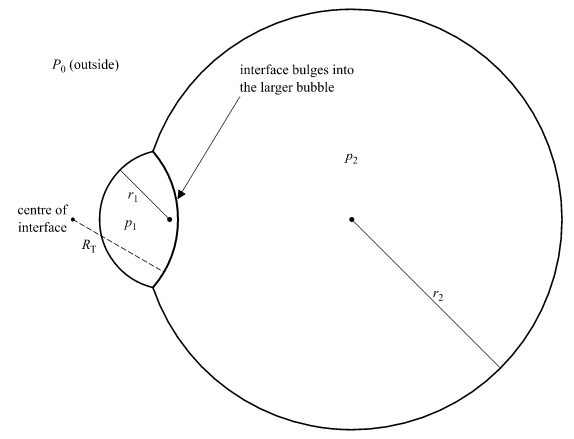
(c) (5 marks)Let the outside (atmospheric) pressure be
P0Pressure inside the smaller bubble:
p1=P0+r14γPressure inside the larger bubble:
p2=P0+r24γSince
r1<r2,
p1>p2, so the common film bulges into the larger bubble
The interface is also a soap film (two surfaces), so the pressure difference across it is
p1−p2=RT4γSubstituting:
r14γ−r24γ=RT4γRT1=r11−r21=r1r2r2−r1RT=r2−r1r1r2(d) (4 marks)Each liquid surface (meniscus) fills the tube, so for a liquid that wets the glass (angle of contact zero) its radius is
rand it is concave towards the air, so the air side has the higher pressure:
pressure in air−pressure in liquid=r2γLeft meniscus of the left plug (air at
P1, liquid at
P2):
P1−P2=r2γ ⇒ P2=P1−r2γRight meniscus of the left plug (air at
P3, liquid at
P2):
P3−P2=r2γ ⇒ P3=P2+r2γSubstituting for
P2:
P3=P1−r2γ+r2γ=P1The right plug gives the same result, so the trapped air is at the outside pressure
Answer: (b)(i)
p−P0=4γ/r; (ii)
1.17×10⁵ Pa; (iii)
0.127 m of mercury (gauge); (c)
RT=r1r2/(r2−r1); (d)
P3=P1Tip: Count the surfaces: a soap bubble has two (
4γ/r), an air bubble in a liquid has one (
2γ/r).