What we are solvingDerive conservation of mechanical energy from Newton's laws, solve a perfectly inelastic collision,
prove the elastic-collision relation for a head-on collision, use it with numbers, give a use of inelastic collisions
and explain rocket motion
Chapter: Mechanics
Topic: work, energy and power; linear momentum and collisions
Concept and formulasNewton's second law:
F=ma; equation of motion:
v2=u2+2asMomentum
p=mv is conserved when no external force acts (Newton's third law)
Elastic collision: momentum and kinetic energy are both conserved
Inelastic collision: momentum is conserved but kinetic energy is not; perfectly inelastic: the bodies stick together
(a) (6 marks)Principle: in a closed system the total energy is constant; for a body moving under gravity alone, K.E. + P.E. is constant
Consider a body of mass
m released from rest at a height
h above the ground
At the top:
P.E.=mgh,
K.E.=0, total
=mghBy Newton's second law the only force, its weight
mg, gives it an acceleration
a=mmg=g downwards
After falling a distance
x, using
v2=u2+2as with
u=0,
a=g,
s=x:
v2=2gxK.E.=21mv2=21m(2gx)=mgxIts height is now
(h−x), so
P.E.=mg(h−x)K.E.+P.E.=mgx+mg(h−x)=mghJust before it hits the ground (
x=h):
K.E.=mgh,
P.E.=0, total
=mghThe total mechanical energy is the same at every point: energy changes from P.E. to K.E. but is neither created nor destroyed
(b) (2 marks)The particles stick together and move with a common velocity
v; momentum is conserved:
m1u1+m2u2=(m1+m2)v0.005×10+0.004×0=(0.005+0.004)vv=0.0090.05=5.56 m s−1in the original direction of the
5 g particle
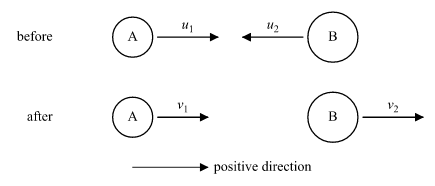
(c)(i) (5 marks)Take A's original direction as positive. Before: A has
+u1, B has
−u2Conservation of momentum (after: A
+v1, B
+v2):
m1u1−m2u2=m1v1+m2v2m1(u1−v1)=m2(u2+v2)...(1)Perfectly elastic, so kinetic energy is conserved:
21m1u12+21m2u22=21m1v12+21m2v22m1(u1−v1)(u1+v1)=m2(v2−u2)(v2+u2)...(2)Dividing (2) by (1):
u1+v1=v2−u2 ⇒ u1+u2=v2−v1This is the rule for every elastic collision: speed of approach = speed of separation
Here the speed of approach is
u1+u2. When the balls move apart in opposite directions after the impact
(A rebounds with speed
v1, B rebounds with speed
v2), the speed of separation is
v1+v2, which gives
u1+u2=v1+v2(With A moving on in its own direction, as worded, the same steps give
u1+u2=v2−v1)
(c)(ii) (2 marks)Momentum is conserved in every collision. Take A's direction as positive:
uA=+15,
uB=−20 m s−1momentum before=2×15+3×(−20)=−30 kg m s−1B moves on in its own direction with
10 m s−1 (
vB=−10 m s−1):
2vA+3×(−10)=−30 ⇒ vA=0Check with energy: K.E. before
=21(2)(152)+21(3)(202)=825 J; after
=0+21(3)(102)=150 J, a loss, which is possible
If B were taken to reverse (
vB=+10), momentum would give
vA=−30 m s−1 and K.E. after
=900+150=1050 J,
more than the
825 J before: impossible, so that reading is rejected
So A is brought to rest: its final velocity is
0 m s−1 (this collision is not elastic)
(c)(iii) (1 mark)The ballistic pendulum, used to measure the speed of a bullet (any one: pile driver, car crumple zones, coupling of railway wagons)
(d) (4 marks)Fuel burns in the combustion chamber and produces hot gases at high pressure
The gases are forced out through the nozzle at the back at a very high speed, so they gain a large backward momentum
No external force acts on the rocket and gas system, so the total momentum stays constant;
the rocket therefore gains an equal forward momentum (the gases push the rocket forward: Newton's third law)
The forward thrust equals the rate of change of momentum of the gases:
F=udtdm (
u = exhaust speed,
dtdm = mass of gas ejected per second)
As fuel is used up the mass of the rocket decreases, so its acceleration increases; the rocket does not need air to push against, so it works in space
Answer: (b)
5.56 m s−1; (c)(i) speed of approach = speed of separation,
u1+u2=v1+v2 when both rebound; (c)(ii)
vA=0 (A stops); (iii) ballistic pendulum
Tip: In collision sums, fix one positive direction and give every velocity a sign before using momentum.