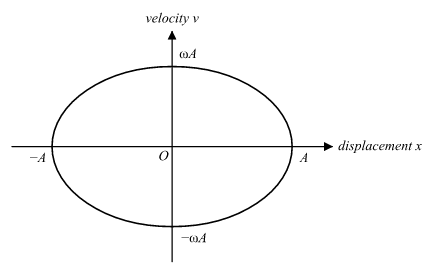
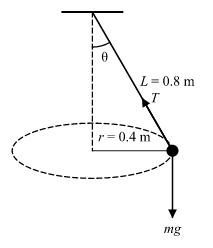
What we are solvingDefine S.H.M., sketch velocity and energy against displacement, find the angular speed and tension of a conical pendulum(m=0.2kg, L=0.8m, r=0.4m), state the law of floatation, prove that upthrust = weight of fluid displaced,and show that a piston on trapped air performs S.H.M.Chapter: MechanicsTopic: simple harmonic motion, circular motion, fluids at restConcept and formulasS.H.M.: a=−ω2x, so v=±ωA2−x2; period T=ω2π, frequency f=2πωCircular motion: the centripetal force mω2r must be supplied by the resultant force towards the centrePressure in a fluid: p=P0+hρg; Boyle's law pV=constant at constant temperature(a) (1 mark)S.H.M. is the periodic motion of a body whose acceleration is always directed towards a fixed point and is directly proportional to its displacement from that point (a=−ω2x)(b)(i) (2 marks)v=±ωA2−x2 gives A2x2+ω2A2v2=1: an ellipse
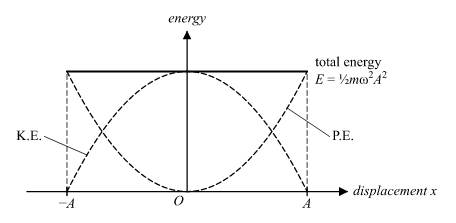
Speed is greatest (ωA) at x=0 and zero at x=±A(b)(ii) (2 marks)Total mechanical energy E=21mω2A2 is the same at every displacement: a horizontal straight line
(P.E. =21mω2x2 and K.E. =21mω2(A2−x2) always add up to E)(c)(i) (3 marks)
Angle of the string to the vertical: sinθ=Lr=0.80.4=0.5, so θ=30∘Vertical: Tcosθ=mg ...(1)Horizontal (towards the centre): Tsinθ=mω2r ...(2)Dividing (2) by (1): tanθ=gω2rω2=rgtanθ=0.49.81×tan30∘=0.49.81×0.5774=14.16ω=3.76rad s−1(c)(ii) (2 marks)From (1):T=cosθmg=cos30∘0.2×9.81=0.8661.962=2.27N(Check: T=mω2L=0.2×14.16×0.8=2.27N)(d)(i) (1 mark)A floating body displaces its own weight of the fluid in which it floats(d)(ii) (4 marks)Consider a cylinder of cross-sectional area A and height h fully immersed upright in a fluid of density ρIts top face is at depth h1 and its bottom face at depth h2=h1+hDownward force on the top face: F1=(P0+h1ρg)AUpward force on the bottom face: F2=(P0+h2ρg)AThe sideways forces on the curved surface cancel in pairsUpthrust=F2−F1=(h2−h1)ρgA=hAρghA=V, the volume of the object, which equals the volume of fluid displaced, soUpthrust=Vρg=(mass of fluid displaced)×g=weight of fluid displaced(e)(i) and (ii) (5 marks)At equilibrium the piston rests with the air at pressure P and volume VPush the piston down a small distance x: the volume becomes V−Ax and the pressure P+ΔPBoyle's law (temperature constant):PV=(P+ΔP)(V−Ax)⇒ΔP≈VPAx(Ax≪V)The extra upward (restoring) force on the piston isF=−ΔP×A=−VPA2xNewton's second law for the piston:Mdt2d2x=−VPA2x⇒dt2d2x=−(MVPA2)xThe acceleration is proportional to the displacement and directed towards the equilibrium position, so the motion is S.H.M. withω2=MVPA2Frequency:f=2πω=2πAMVPAnswer: (c)(i) ω=3.76rad s−1; (ii) T=2.27N; (e) f=2πAMVPTip: To prove S.H.M., always reach the form a=−(positive constant)×x; the constant is ω2.