What we are solvingState Kepler's laws and derive the third law, explain weightlessness, define uniform velocity,find how far a car travels to catch a bus (30m s−1; car starts 10s later with 4m s−2),and derive the range of a projectileChapter: MechanicsTopic: gravitation, linear motion, projectile motionConcept and formulasNewton's law of gravitation: F=r2GMmCentripetal force: F=mω2r, with ω=T2πUniform motion: s=vt; uniform acceleration: s=ut+21at2(a) (3 marks)1. Each planet moves round the sun in an ellipse, with the sun at one focus2. The line joining the sun to a planet sweeps out equal areas in equal times3. The square of the period of revolution of a planet is directly proportional to the cube of its mean distance from the sun (T2∝r3)(b) (3 marks)Take a planet of mass m moving round the sun (mass M) in a circle of radius r with period TThe gravitational pull provides the centripetal force:r2GMm=mω2r=m(T2π)2rT2=(GM4π2)r3GM4π2 is a constant for all planets, so T2∝r3, which is Kepler's third law(c) (4 marks)Weight is felt through the reaction force of the support on the bodyA body is weightless when this reaction is zero, which happens when the body and its support fall freely together with the same acceleration gIn a lift accelerating downwards with a: mg−R=ma, so R=m(g−a); if the lift falls freely, a=g and R=0In an orbiting satellite, gravity provides the centripetal force: the astronaut and the spacecraft both accelerate towards the earth at g′=rv2So mg′−R=rmv2 gives R=0: the astronaut presses on nothing and feels weightless, although gravity still acts on him(d) (1 mark)Uniform velocity is when a body covers equal displacements in equal time intervals in a fixed direction (constant speed and direction; zero acceleration)(e) (4 marks)Let the car move for a time t before it catches the bus; the bus has then moved for (t+10)s from the same pointDistance of the car: s=21at2=21×4×t2=2t2Distance of the bus: s=30(t+10)They meet when the distances are equal:2t2=30t+300⇒t2−15t−150=0t=215+152+4×150=215+28.72=21.86ss=2t2=2×21.862=956m(Check: bus 30×31.86=956m)(f) (5 marks)
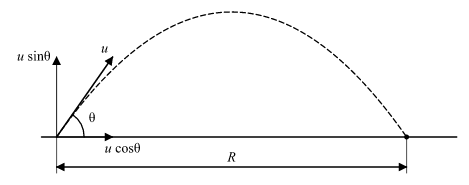
Resolve the velocity: horizontal ucosθ (constant, no horizontal force), vertical usinθ (acceleration −g)Vertical motion: the stone lands when its vertical displacement is zero:0=(usinθ)t−21gt2⇒t=g2usinθHorizontal distance in this time (the range R):R=(ucosθ)t=ucosθ×g2usinθ=g2u2sinθcosθR=gu2sin2θAnswer: (b) T2=GM4π2r3; (e) 956m (after 21.9s); (f) R=gu2sin2θTip: In catch-up problems the two bodies have equal distances but different times: write both from the same starting point.