What we are solvingDefine thermal conductivity, explain conduction in an insulator, describe Lee's disc method for a poor conductor,explain how a black body is made, and find the temperature of a planet 2.3×10¹¹m from a sun of radius 7.0×10⁸m at 6000KChapter: HeatTopic: thermal conduction, black body radiation (Stefan's law)Concept and formulasSteady heat flow: tQ=kAxθ1−θ2 (k in W m−1K−1, A area, x thickness)Stefan's law: power radiated by a black body P=σAT4Intensity at distance d from a source of power P: I=4πd2P(a)(i) (1 mark)Thermal conductivity is the rate of heat flow per unit area per unit temperature gradient, at right angles to the faces, under steady conditions(a)(ii) (3 marks)An insulator has no free electrons; heat is carried only by vibrations of the atoms (molecules)Atoms at the hot end gain energy and vibrate with larger amplitudeThrough the bonds they make their neighbours vibrate more, so energy is passed from atom to atom towards the cold endThe atoms are heavy and the process is slow, so insulators conduct heat poorly(b)(i) (8 marks)Lee's disc method:
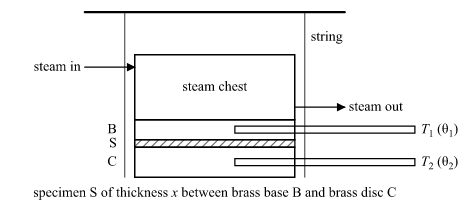
The specimen S is a thin disc of large area (thickness x, area A, both measured), so that heat flows fast enough and little is lost from its sidesS is placed between the brass base B of a steam chest and a brass disc C (Lee's disc) of known mass m and specific heat capacity c, hung from a standSteam is passed through the chest until thermometers T1 and T2 show steady readings θ1 and θ2At the steady state, heat flowing through S per second = heat lost per second by C at θ2The specimen is removed and C is heated directly on B until it is about 10∘C above θ2B is removed, S is put on top of C (so C cools under the same conditions), and the temperature of C is recorded at regular time intervals as it coolsA cooling curve (temperature against time) is plotted and the slope (dtdθ)θ2 is found at θ2kAxθ1−θ2=mc(dtdθ)θ2k=A(θ1−θ2)mcx(dtdθ)θ2(c)(i) (3 marks)
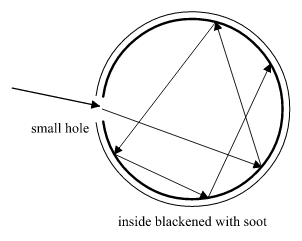
Take a hollow enclosure (a closed metal sphere) with a very small hole, its inside blackened with soot (lamp black)Radiation entering the hole is reflected many times inside; part is absorbed at each reflectionVery little can find its way back out through the small hole, so almost all of it is absorbed: the hole behaves as a black bodyWhen the enclosure is kept at a uniform temperature, the radiation coming out of the hole is black-body radiation(c)(ii) (5 marks)Assume the sun and the planet are black bodies, the planet has the same temperature all over and loses heat only by radiationPower radiated by the sun (radius R, temperature Ts): P=σ4πR2Ts4Power falling on the planet (radius r, distance d) through its cross-section πr2:Pin=4πd2σ4πR2Ts4×πr2Power radiated by the planet from its whole surface: Pout=σ4πr2Tp4At a steady temperature, Pin=Pout:d2R2Ts4πr2=4πr2Tp4⇒Tp=Ts2dRTp=6000×2×2.3×10117.0×108=6000×1.522×10−3=6000×0.03901Tp=234KAnswer: (b) k=A(θ1−θ2)mcx(dtdθ)θ2; (c)(ii) Tp≈234KTip: The planet absorbs on its disc πr2 but radiates from its sphere 4πr2; r cancels, so the planet's size is not needed.