What we are solvingThermometric properties of gas thermometers, why thermometers disagree, a temperature on a constant-volume gas thermometer,
definitions of specific heat capacity and specific latent heat, the continuous-flow method, a latent heat calculation
from two runs, and sea and land breezes
Chapter: Heat
Topic: thermometry, calorimetry (specific heat capacity, latent heat)
Concept and formulasTemperature on the scale of a property
X:
θ=X100−X0Xθ−X0×100∘CElectrical energy supplied:
E=IVtHeat to vaporise a mass
m:
Q=mL; heat to warm a mass
m:
Q=mcΔθ(a)(i) (1 mark)Pressure of a fixed mass of gas at constant volume
Volume of a fixed mass of gas at constant pressure
(a)(ii) (1 mark)Resistance of platinum and expansion of a liquid do not vary with temperature in the same (linear) way;
each scale assumes a linear change between the fixed points, so the two agree only at the fixed points
(b) (2 marks)The pressure of the gas is
H+h, where
h is the difference in mercury levels; the atmospheric part
H cancels in the ratio
θ=h100−h0hθ−h0×100=140−(−100)30−(−100)×100θ=240130×100=54.2∘C(c) (2 marks)(i) Specific heat capacity is the heat needed to raise the temperature of
1 kg of a substance by
1 K(ii) Specific latent heat of vaporisation is the heat needed to change
1 kg of a liquid at its boiling point into vapour without a change of temperature
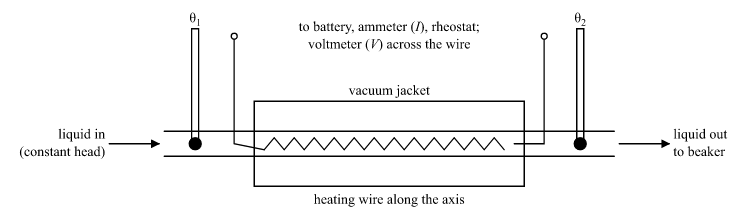
(d)(i) (5 marks)Callendar and Barnes continuous-flow method:
The liquid flows at a steady rate from a constant-head tank through a glass tube with a heating wire along its axis
A vacuum jacket round the tube reduces heat loss; thermometers measure the inlet and outlet temperatures
θ1 and
θ2The current is switched on and, when the temperatures are steady,
I1,
V1,
θ1,
θ2 and the mass
m1 collected in time
t are recorded:
I1V1t=m1c(θ2−θ1)+hThe flow rate is changed and
I and
V adjusted until
θ1 and
θ2 are the same as before;
I2,
V2 and
m2 (in the same time
t) are recorded:
I2V2t=m2c(θ2−θ1)+hThe heat loss
h is the same in both, because the temperatures are the same. Subtracting:
c=(m1−m2)(θ2−θ1)(I1V1−I2V2)tAdvantage: at the steady state no heat is used to warm the apparatus, and the heat loss is removed by the two runs
(d)(ii) (5 marks)In each run the electrical energy vaporises the water and covers the heat loss
H, which is the same in both runs (same temperature, same time)
P1t=m1L+H,P2t=m2L+HL=m1−m2(P1−P2)tP1=5.25×2.58=13.545 W,
P2=3.20×1.57=5.024 W,
t=20×60=1200 sL=(6.85−2.38)×10−3(13.545−5.024)×1200=4.47×10−310225L=2.29×10⁶ J kg−1(e)(i) (2 marks)During the day the land heats up faster than the sea, because the land has a lower specific heat capacity than water
Air over the land is warmed, expands, becomes less dense and rises; cooler, denser air from over the sea (or Lake Victoria) moves in to take its place: a sea breeze blows from sea to land
(e)(ii) (2 marks)At night the land loses heat and cools faster than the sea, so the water is now warmer than the land
Air over the sea is warmer and rises; cooler air from the land flows out to replace it: a land breeze blows from land to sea
Answer: (b)
54.2∘C; (d)(i)
c=(m1−m2)(θ2−θ1)(I1V1−I2V2)t; (d)(ii)
L=2.29×10⁶ J kg−1Tip: Two runs with the same temperatures and time cancel the unknown heat loss: subtract the equations.