What we are solvingState and verify Boyle's law, compare real and ideal gases, sketch isotherms, define s.v.p.,
find the total pressure in a sealed container heated from
27∘C to
80∘C,
and find the temperature of one mole of gas from its r.m.s. speed, density and volume
Chapter: Heat
Topic: gas laws, vapours, kinetic theory of gases
Concept and formulasBoyle's law
pV=constant; pressure law at constant volume
Tp=constant (
T in kelvin)
Dalton's law: total pressure = pressure of the air + pressure of the vapour
Kinetic theory:
p=31ρc2; ideal gas equation
pV=nRT(a)(i) (1 mark)The pressure of a fixed mass of gas is inversely proportional to its volume, provided the temperature is constant
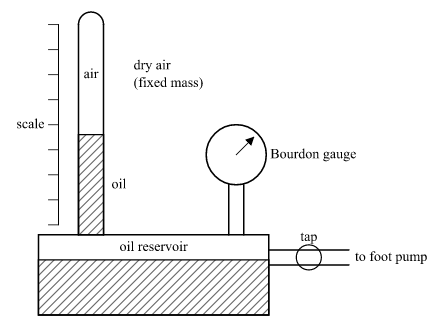
(a)(ii) (5 marks)A fixed mass of dry air is trapped above oil in a uniform, thick-walled glass tube with a scale beside it
The oil reservoir is connected to a Bourdon gauge and, through a tap, to a foot pump
The length
l of the air column is read from the scale (volume
V=Al∝l, since the tube is uniform) and the pressure
p from the gauge
The pump is used to raise the pressure in steps; after each step we wait a moment for the air to return to room temperature, then read
p and
lA graph of
p against
l1 (or
V1) is a straight line through the origin, so
p∝V1 at constant temperature: Boyle's law is verified
(b)(i) (4 marks)1. Ideal gases obey the gas laws at all temperatures and pressures; real gases obey them only at low pressure and high temperature
2. Ideal gas molecules have no forces between them; real gas molecules attract one another
3. The volume of ideal gas molecules is negligible; real gas molecules have a definite volume
4. Ideal gases cannot be liquefied; real gases can be liquefied when cooled below the critical temperature (also:
pV=nRT holds exactly only for an ideal gas)
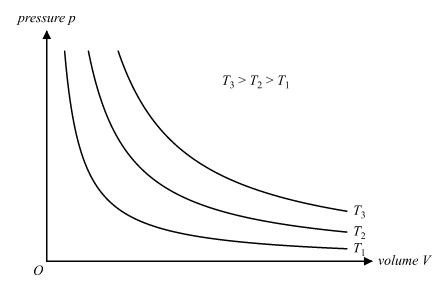
(b)(ii) (2 marks)Each curve is a rectangular hyperbola (
pV=nRT = constant); the higher the temperature, the further the curve is from the axes
(c)(i) (1 mark)Saturated vapour pressure is the pressure exerted by a vapour which is in dynamic equilibrium with its own liquid (in a closed space) at a given temperature
(c)(ii) (4 marks)At
27∘C the pressure of the air alone is
pair=1.01×10⁵−2.0×103=9.9×10⁴ PaThe container is sealed, so the air is heated at constant volume (
T1=300 K,
T2=353 K):
pair′=9.9×104×300353=1.1649×10⁵ PaThe vapour stays saturated, so its pressure is the s.v.p. at
80∘C,
3.51×10³ Pa (a saturated vapour does not obey the pressure law)
ptotal=1.1649×10⁵+3.51×103=1.20×10⁵ Pa(d) (3 marks)Pressure from kinetic theory:
p=31ρc2=31×9.0×10−2×44.722=31×0.09×1999.9=60.0 PaFor one mole,
pV=RT:
T=RpV=8.3160.0×42.0=303 KAnswer: (c)(ii)
1.20×10⁵ Pa; (d)
T=303 K (
30∘C)
Tip: Treat the air and the vapour separately: only the air follows the gas laws; a saturated vapour takes the s.v.p. at the new temperature.