What we are solvingCathode rays: meaning, how they differ from gamma rays, how they are produced; Thomson's experiment for e/m;an electron of 480eV at right angles to B=1.5×10⁻³T: show the path is a circle and find its radiusChapter: Modern physicsTopic: cathode rays, specific charge of the electronConcept and formulasForce on a charge moving in a magnetic field: F=Bev (at right angles to v and B)Force in an electric field: F=eE, E=dVEnergy gained across a p.d. V: eV=21mv2; 1eV=1.6×10⁻¹⁹J(a)(i) (1 mark)Cathode rays are streams of fast-moving electrons (from the cathode of a discharge or vacuum tube)(a)(ii) (2 marks)Cathode rays are negatively charged particles with mass, deflected by electric and magnetic fields, travelling slower than lightGamma rays are electromagnetic waves (photons) with no charge, not deflected by the fields, travelling at the speed of light and far more penetrating(a)(iii) (4 marks)A cathode (a filament, or a metal coated with oxides) is heated in an evacuated glass tubeIts free electrons gain enough energy to escape from the surface: thermionic emissionA high p.d. between the cathode and the anode accelerates the electrons to high speed towards the anodeThe electrons pass through a hole in the anode as a narrow beam; the tube is evacuated so they are not stopped by collisions with gas molecules(b) (6 marks)J.J. Thomson's method:
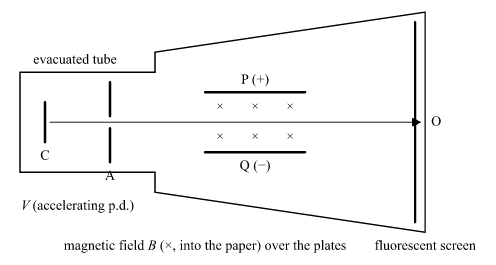
Electrons from the hot cathode C are accelerated by a p.d. V to the anode A and pass through its hole as a fine beamWith no fields, the beam makes a spot at O on the fluorescent screenA p.d. Vp is applied to plates P and Q (separation d): the electric field E=dVp deflects the beamA uniform magnetic field B (from a pair of coils) is applied at right angles to E over the same region and adjusted until the spot returns to OThen the two forces balance: eE=Bev, so v=BEThe kinetic energy came from the accelerating p.d.: eV=21mv2me=2Vv2=2VB2E2B is found from the coil current, V, Vp and d are measured, so e/m is found(c)(i) (3 marks)The magnetic force F=Bev is always at right angles to the velocity (Fleming's left-hand rule)So it does no work: the speed v stays constant and the size of the force Bev stays constantA force of constant size always at right angles to the motion is a centripetal force, so the electron moves in a circle: Bev=rmv2(c)(ii) (4 marks)Kinetic energy:21mv2=480×1.6×10−19=7.68×10⁻¹⁷Jv=9.11×10−312×7.68×10−17=1.30×10⁷m s−1Radius from Bev=rmv2:r=Bemv=1.5×10−3×1.6×10−199.11×10−31×1.30×107=4.93×10⁻²mAnswer: (b) me=2VB2E2; (c)(ii) r≈4.9×10⁻²m (about 4.9cm)Tip: Convert eV to joules before using 21mv2.