What we are solvingDefine threshold frequency and work function, explain what UV light does to a charged zinc plate on a gold leaf electroscope,
find the work function and threshold frequency for light of
0.50 μm giving photoelectrons of
6.0×10⁵ m s−1,
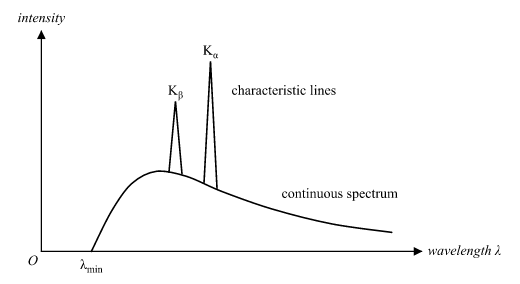
and sketch and explain an X-ray spectrum
Chapter: Modern physics
Topic: photoelectric effect, X-rays
Concept and formulasPhoton energy
E=hf=λhcEinstein's equation:
hf=W0+21mvmax2, with
W0=hf0X-ray cut-off:
eV=λminhc(a)(i) (1 mark)Threshold frequency is the minimum frequency of radiation that can cause photoelectric emission from a given metal surface
(a)(ii) (1 mark)Work function is the minimum energy needed to remove an electron from the surface of a metal
(b)(i) (3 marks)The leaf falls gradually (its divergence decreases)
UV photons have energy greater than the work function of zinc, so electrons are emitted from the zinc plate
The plate is negative, so the emitted electrons are repelled away; the electroscope loses negative charge and the leaf collapses
(b)(ii) (3 marks)The leaf divergence does not change
Photoelectrons are still emitted by the UV light
But the positively charged plate attracts them back, so there is no net loss of charge and the leaf stays as it was
(c)(i) (4 marks)Photon energy:
E=λhc=0.50×10−66.6×10−34×3.0×108=3.96×10⁻¹⁹ JMaximum kinetic energy of the photoelectrons:
21mvmax2=21×9.11×10−31×(6.0×105)2=1.64×10⁻¹⁹ JW0=3.96×10⁻¹⁹−1.64×10−19=2.32×10⁻¹⁹ J (=1.45 eV)(c)(ii) (2 marks)f0=hW0=6.6×10−342.32×10−19=3.52×10¹⁴ Hz(d)(i) (2 marks)(d)(ii) (4 marks)1. Continuous spectrum: the fast electrons are slowed down by the nuclei of the target atoms; each loses a different amount of energy, so X-rays of all wavelengths above a minimum are produced (braking radiation)
2. Sharp cut-off at
λmin: an electron that loses all its kinetic energy in one collision gives the shortest wavelength,
eV=λminhc; it depends only on the tube voltage
V3. Characteristic lines (
Kα,
Kβ): incident electrons knock out electrons from inner shells (K shell) of the target atoms; electrons from higher shells fall into the vacancies and emit X-ray photons of definite energies
4. The wavelengths of these lines depend only on the target material, not on the tube voltage
Answer: (c)(i)
W0=2.32×10⁻¹⁹ J (
1.45 eV); (ii)
f0=3.52×10¹⁴ HzTip: In the electroscope question, the sign of the charge decides whether the emitted electrons escape (negative) or are pulled back (positive).