What we are solvingPart (a): define the principal focus of a diverging lens
Part (b): derive
u1+v1=f1 for a diverging lens from a ray diagram
Part (c): Galilean telescope,
fo=15 cm,
fe=5 cm, final image
30 cm from the eyepiece: find the angular magnification and the lens separation
Parts (d), (e): one disadvantage of the Galilean telescope, and accommodation of the eye
Chapter: Optics (refraction through lenses, optical instruments)
Topic: thin lenses, telescopes, the eye
(a) (1 mark)The principal focus of a diverging lens is the point on the principal axis
from which rays parallel and close to the principal axis appear to diverge after refraction through the lens
(b) (6 marks)Sign convention: real is positive; virtual distances (and
f of a diverging lens) are negative
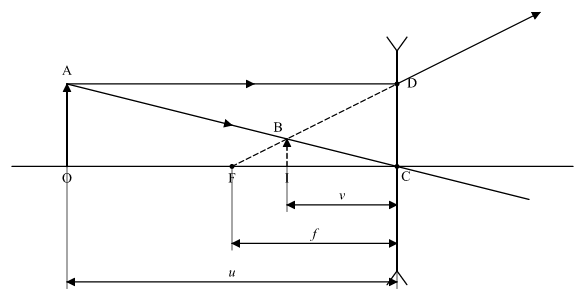
Object OA of height
h at distance
u from the optical centre C; F is the principal focus
Ray AD parallel to the axis is refracted as if it came from F
Ray AC through the optical centre passes straight through
The two refracted rays appear to come from B: IB is the virtual, upright image
Use similar triangles (magnitudes only):
Triangles OAC and IBC are similar:
OAIB=COCI=uv...(1)Triangles FIB and FCD are similar, and
CD=OA:
CDIB=FCFI=ff−v...(2)Equating (1) and (2):
uv=ff−v ⇒ vf=uf−uvDivide every term by
uvf:
u1=v1−f1 ⇒ v1−u1=f1 (magnitudes)The image and the focus are virtual, so put
v→−v and
f→−f:
−v1−u1=−f1 ⇒ u1+v1=f1(c)(i) (4 marks)Concept: the objective forms an image of the distant object at its focus,
15 cm behind it
The concave eyepiece intercepts the rays before that image, so the image is a virtual object for the eyepiece
Eyepiece:
fe=−5 cm, final image virtual:
v=−30 cmu1=fe1−v1=−51+301=30−6+1=−61u=−6 cm (virtual object 6 cm behind the eyepiece)Let
h = height of the image formed by the objective
Angle subtended by the distant object at the objective:
α=foh=15hFinal image height:
h′=h×uv=h×630=5hAngle subtended by the final image at the eye (close to the eyepiece):
β=30h′=305h=6hM=αβ=h/15h/6=615=2.5(c)(ii) (2 marks)The objective's image lies
15 cm from the objective and
6 cm beyond the eyepiece
separation=15−6=9 cm(d) (4 marks)Disadvantage: the Galilean telescope has a very small field of view
Its eye ring (exit pupil) is virtual and lies between the two lenses
So the eye cannot be placed at the eye ring; it is placed close to the eyepiece instead
Only rays close to the axis then enter the eye; rays from the edges of the object miss the pupil
So only a small part of the object is seen at a time (small field of view)
(Also: no real intermediate image is formed, so cross-wires cannot be used for measurements)
(e) (3 marks)Accommodation is the ability of the eye to change the focal length of its lens
so that objects at different distances (from the near point to the far point) are focused sharply on the retina
For a near object the ciliary muscles contract, the lens becomes thicker (more curved) and its focal length decreases
For a distant object the ciliary muscles relax, the lens becomes thinner and its focal length increases
Answer: (c)(i) angular magnification
=2.5; (c)(ii) separation
=9 cm; (b)
u1+v1=f1 shown
Tip: In a Galilean telescope the lens separation is
fo−∣ue∣, not
fo+fe