What we are solvingPart (a): laws of reflection and multiple images in a thick plane mirror
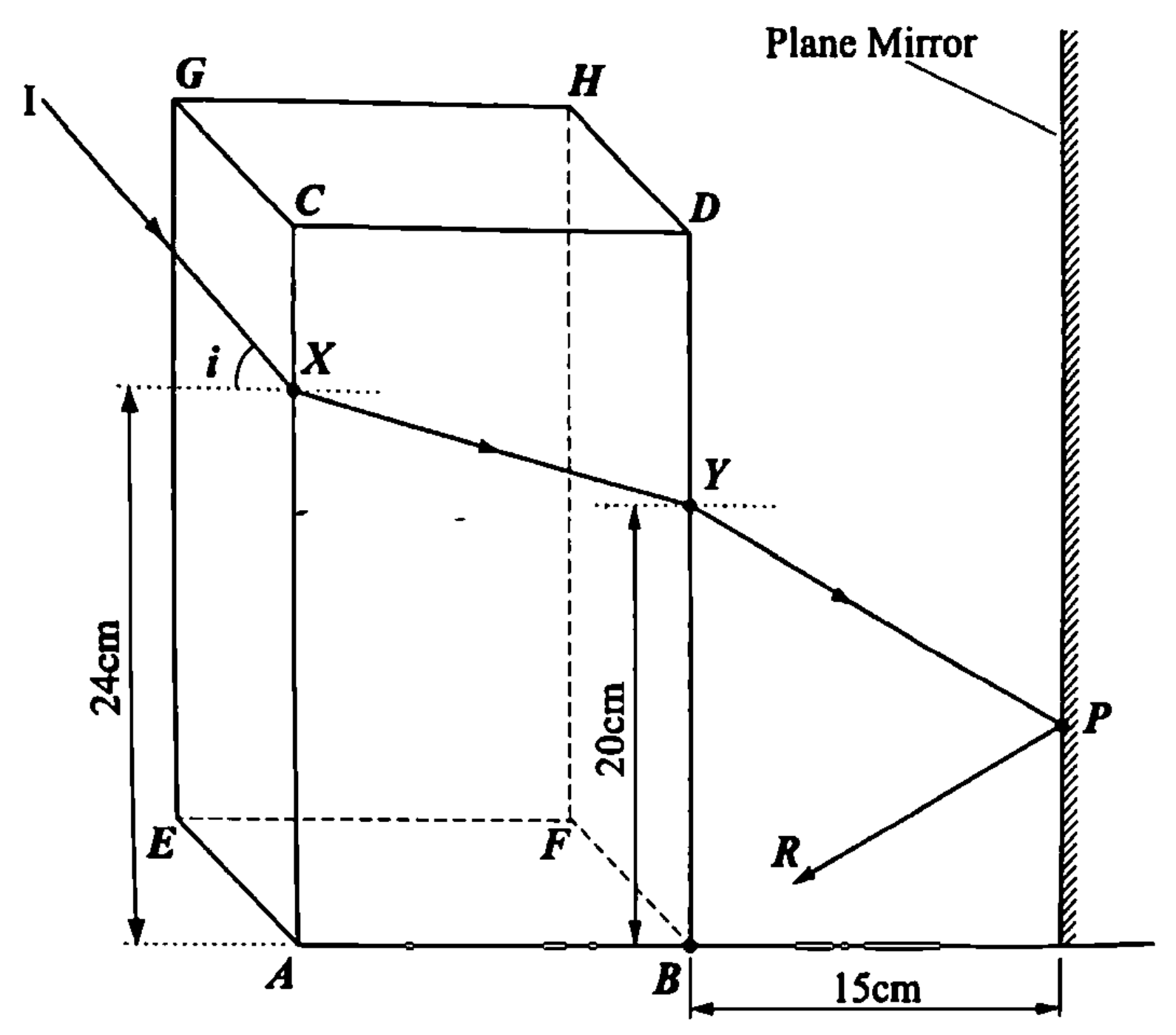
Part (b): ray enters a glass block (
n=1.52) at X,
24 cm above the base, leaves at Y,
20 cm above B
it reflects at P on a plane mirror
15 cm from B and the reflected ray passes through B: find angle
i and width AB
Part (c): measure the focal length of a concave mirror; part (d): focal length of two thin lenses in contact
Chapter: Optics (reflection and refraction of light)
Topic: plane mirrors, refraction through a parallel-sided block, curved mirrors, lenses
(a)(i) (2 marks)1. The incident ray, the reflected ray and the normal at the point of incidence all lie in the same plane
2. The angle of incidence is equal to the angle of reflection
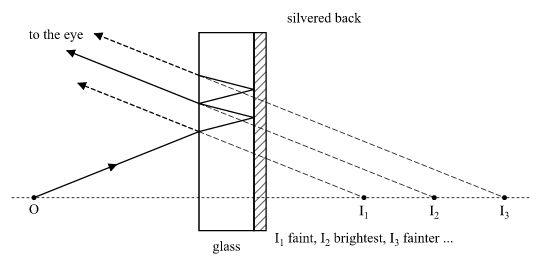
(a)(ii) (3 marks)A thick mirror is a glass plate silvered at the back
Light from O is partly reflected at the front glass surface, giving a faint image
I1Most of the light is refracted into the glass, reflected at the silvered back and refracted out, giving the brightest image
I2Part of this light is reflected again internally at the front surface, returns to the silvered back and emerges, giving
I3, and so on
Each repetition gives a further image, fainter than the one before
(b)(i) (3 marks)Concept: the image of B in the mirror is B',
15 cm behind the mirror on the base line
A ray that reflects at P and passes through B must travel along the line Y P B' before reflection
Horizontal distance from Y to B'
=15+15=30 cm; Y is
20 cm above the base
The normal at Y is horizontal, so the angle of emergence
e satisfies
tane=3020 ⇒ e=33.7∘The faces through X and Y are parallel, so the ray inside makes the same angle
r with both normals
Snell's law at X and at Y:
sini=nsinr=sinei=e=33.7∘(b)(ii) (3 marks)Angle of refraction inside the glass:
sinr=1.52sin33.7∘=1.520.5547=0.3649 ⇒ r=21.4∘Inside the block the ray falls from
24 cm to
20 cm, a drop of
4 cm across the width AB
tanr=AB4 ⇒ AB=tan21.4∘4=0.3924=10.2 cm(c) (5 marks)Method: object and screen (u and v method)
1. Mount the concave mirror on a stand facing an illuminated object (a cross-wire in front of a lamp) along a metre rule
2. Place the object at distance
u from the mirror, beyond its focus
3. Move a white screen until a sharp inverted image of the cross-wire is formed on it; measure the image distance
v4. Repeat for several values of
u and record
u,
v,
u1 and
v1 in a table
5. Plot a graph of
v1 against
u1: a straight line with intercepts on both axes equal to
f1u1+v1=f1 ⇒ f=intercept1(Quick check: an object pin coincides with its own image, with no parallax, at the centre of curvature:
f=2r)
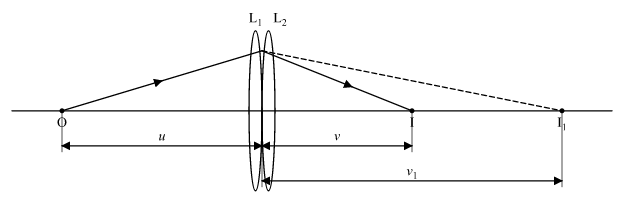
(d)(i) (4 marks)Object O at distance
u from the thin lenses
L1 and
L2 in contact
L1 alone would form the image
I1 at distance
v1:
u1+v11=f11...(1)The rays meet
L2 before reaching
I1, so
I1 is a virtual object for
L2 at distance
−v1 (lenses thin and in contact)
L2 forms the final image I at distance
v:
−v11+v1=f21...(2)Adding (1) and (2):
u1+v1=f11+f21For the combination as a single lens of focal length
f:
u1+v1=f1f1=f11+f21Answer: (b)(i)
i=33.7∘; (b)(ii)
AB=10.2 cmTip: Through a parallel-sided block the emergent ray is parallel to the incident ray, so
i=e