What we are solvingInterference: meaning, conditions, the fringe width in Young's double slit experiment, effect of wider slits
Diffraction: meaning, and why sound but not light reaches an observer outside a closed house
Polarisation: two methods, and the refractive index when the reflected light is completely polarised and
r=35.2∘Chapter: Waves (physical optics)
Topic: interference, diffraction and polarisation of light
(a)(i) (1 mark)Interference is the superposition of waves from two coherent sources overlapping in a region
giving a pattern of points of maximum (reinforcement) and minimum (cancellation) intensity
(a)(ii) (2 marks)1. The sources must be coherent: same frequency and a constant phase difference
2. The waves must have equal or nearly equal amplitudes
(Also: the slits must be narrow and close together)
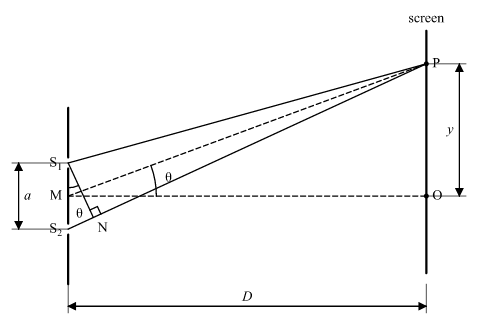
(b)(i) (5 marks)S1 and S2 are the slits, separation
a; the screen is at distance
D; O is opposite the midpoint M
Consider a point P on the screen at distance
y from O; MP makes angle
θ with MO
Draw S1N perpendicular to S2P; since
D≫a, S1P = NP
path difference=S2P−S1P=S2N=asinθFor small
θ:
sinθ≈tanθ=Dypath difference=DayP is on a bright fringe when the path difference is a whole number of wavelengths:
Dayn=nλ ⇒ yn=anλDFringe width = distance between neighbouring bright fringes:
w=yn+1−yn=a(n+1)λD−anλD=aλD(b)(ii) (3 marks)More light passes through each slit, so the fringes become brighter
Each wide slit acts as many sources; their fringe systems are slightly displaced and overlap
So the dark fringes are no longer dark: contrast falls and the fringes become less distinct, finally disappearing into uniform illumination
The fringe width
aλD is unchanged (it depends on the slit separation, not the slit width)
(c)(i) (1 mark)Diffraction is the spreading of waves as they pass through an opening (aperture) or round the edge of an obstacle
(c)(ii) (3 marks)Diffraction is appreciable only when the wavelength is comparable to the size of the opening or obstacle
Sound has long wavelengths (about
0.3 m to
3 m), comparable to gaps round doors, windows and walls, so it diffracts round them and spreads out to the observer (the walls also vibrate and pass the sound on)
Light has a very short wavelength (about
5×10⁻⁷ m), so it hardly diffracts; it travels in straight lines and is stopped by the opaque walls
So the observer hears the sound but does not see the light
(d)(i) (2 marks)1. Reflection at a surface at the polarising (Brewster) angle
2. Selective absorption by a polaroid sheet (dichroism)
(Also: double refraction in a Nicol prism, scattering)
(d)(ii) (3 marks)Concept: when reflected light is completely plane polarised (Brewster's law), the reflected and refracted rays are perpendicular
ip+r=90∘andn=tanipip=90∘−35.2∘=54.8∘n=tan54.8∘=1.42Answer: (b)(i) fringe width
w=aλD; (d)(ii)
n=1.42Tip: Wider slits change the brightness and contrast; wider slit separation changes the fringe width