What we are solvingForced oscillation and resonance; a sonometer used to find the frequency of a tuning fork; quality of a noteA person moves at 1.5m s−1 away from an observer towards a wall; the observer hears 5 beats per second; speed of sound 336m s−1: find the whistle frequencyDoppler effect for a star; effect of pressure and temperature on the speed of soundChapter: Waves (sound)Topic: vibrations in strings, beats, Doppler effect, speed of sound(a)(i)(1 mark)Forced oscillation is oscillation of a body made to vibrate by an external periodic force, at the frequency of that force (not its natural frequency)(a)(ii)(1 mark)Resonance is when a body is set into vibration by a periodic force whose frequency equals the body's natural frequency, so it vibrates with maximum amplitude(b)(i)(5 marks)
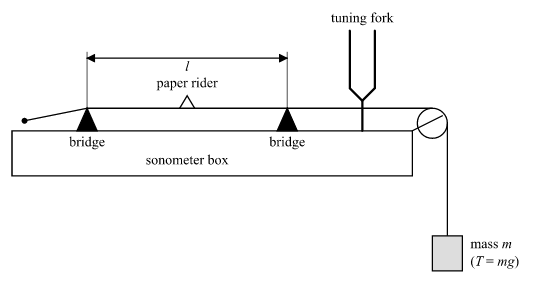
1. Stretch the sonometer wire over two bridges with a fixed tension T=mg from a hanging mass2. Place a small paper rider at the middle of the wire between the bridges3. Strike the tuning fork and press its stem on the sonometer box4. Starting with the bridges close together, slowly increase the length l between them until the rider flies off (resonance); measure l5. Find the mass per unit length μ of the wire (weigh a measured length of the same wire)f=2l1μTRepeat with other tensions and take the mean value of f(b)(ii)(2 marks)The quality of a note depends on the number and relative intensities of the overtones present with the fundamentalA vibrating wire gives the fundamental with many overtones, while a tuning fork gives an almost pure fundamental (its overtones die away quickly), so the notes differ in quality(c)(i)(2 marks)The observer receives two sounds: the direct sound from the receding whistle (lowered frequency)and the sound reflected from the wall, which the whistle approaches (raised frequency)The two slightly different frequencies superpose, so the loudness rises and falls periodically: beats(c)(ii)(4 marks)Doppler formula for a moving source and stationary observer: f′=v∓usvfv=336m s−1 (speed of sound), us=1.5m s−1 (speed of the whistle), f = whistle frequencyDirect sound (source moving away): f1=v+usvfSound received by the wall (source approaching) and reflected unchanged to the observer: f2=v−usvfBeat frequency:f2−f1=fv(v−us1−v+us1)=v2−us22usvf=5f=2usv5(v2−us2)=2×1.5×3365(3362−1.52)=10085×112893.75f=560Hz(d)(3 marks)Light from the star is passed through a spectrometer and its line spectrum (e.g. hydrogen lines) is compared with the spectrum of the same element in the laboratoryIf the star moves away from the earth, the lines are shifted to longer wavelengths (red shift); if it approaches, they shift to shorter wavelengths (blue shift)The shift Δλ of a line of wavelength λ is measured and the speed found fromu=λcΔλ(e)(i)(1 mark)No change: v=ργP and ρP stays constant at constant temperature(e)(ii)(1 mark)The speed increases (v∝T)Answer: (c)(ii) f≈560HzTip: Treat the wall as a stationary observer that re-emits the frequency it receives