What we are solvingMagnetic flux density: definition and measurement with a Hall probe
Force on a
30.2 cm conductor carrying
8 A at
56∘ to a
0.3 T field
Hall effect: definition, Hall voltage, and charge carrier density for breadth
0.070 mm,
B=2.2 T,
I=12 A,
VH=10 μVChapter: Magnetism and electromagnetism
Topic: force on a current, Hall effect
(a) (1 mark)Magnetic flux density is the force acting per unit length on a conductor carrying a current of 1 A placed perpendicular to the magnetic field
B=IlF; unit: tesla (T)
(b)(i) (5 marks)A Hall probe is a thin slice of semiconductor carrying a constant current
I, with a high-resistance voltmeter across its Hall contacts
1. Calibrate: place the probe in a known field
B0 (e.g. at the centre of a long solenoid,
B0=μ0nIs) with its face perpendicular to the field; note the Hall voltage
V02. Place the probe in the unknown field with the same probe current
I3. Rotate the probe until the Hall voltage is maximum (face perpendicular to the field); read
VH4. Since
VH∝B for a fixed current:
B=V0VHB0(b)(ii) (4 marks)F=BIlsinθB=0.3 T,
I=8 A,
l=0.302 m,
θ=56∘F=0.3×8×0.302×sin56∘=0.7248×0.829=0.60 N(c)(i) (1 mark)Hall effect is the setting up of a potential difference across a current-carrying conductor placed in a magnetic field,
in a direction perpendicular to both the current and the field
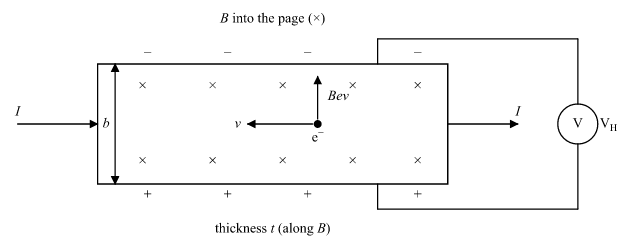
(c)(ii) (5 marks)Slab of breadth
b and thickness
t (along B);
n charge carriers per unit volume, each of charge
e, drift velocity
vCurrent:
I=nAev=n(bt)ev, so
v=nbteIThe magnetic force
Bev pushes the carriers to one face; charges build up on opposite faces and set up an electric field
E=bVHAt equilibrium the electric force balances the magnetic force:
eE=Bev ⇒ beVH=Bev ⇒ VH=BvbSubstitute
v:
VH=BbnbteI=nteBI(c)(iii) (4 marks)From
VH=nteBI, with
t=0.070 mm=7.0×10⁻⁵ m (the dimension along the field):
n=teVHBI=7.0×10−5×1.6×10−19×10×10−62.2×12n=1.12×10−2826.4=2.36×1029 m−3Key point: The Hall voltage gives the number of charge carriers per unit volume. A number per atom would also need the density and molar mass of the metal, which are not given
Answer: (b)(ii)
F=0.60 N; (c)(ii)
VH=nteBI; (c)(iii)
n=2.36×1029 charge carriers per
m3Tip: In
VH=nteBI,
t is the thickness measured along B, not the width across which
VH appears