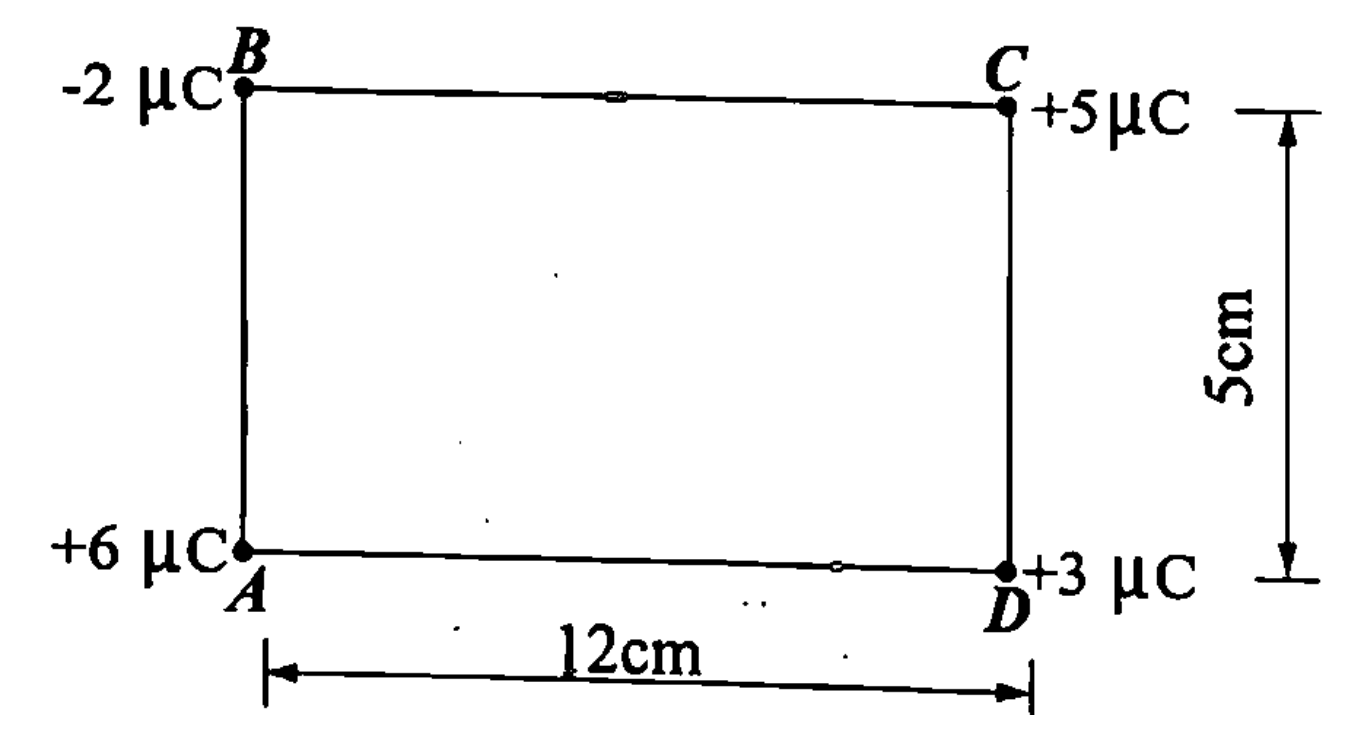
What we are solvingElectric field and electric potential energy: definitions, derivation, and the change from Q to P near a positive chargeCharges +6, −2, +5, +3μC at A, B, C, D of a 12cm×5cm rectangle: force on the charge at DField on a pear-shaped conductor; two applications of electrostaticsChapter: ElectrostaticsTopic: Coulomb's law, electric field and potential energy, charge distribution on conductors(a)(i)(1 mark)An electric field is a region (space) in which an electric force is experienced by a charge placed in it(a)(ii)(1 mark)Electric potential energy of a charge at a point is the work done in bringing the charge from infinity to that point in the field(b)(i)(5 marks)Let a charge Q be fixed at O and a charge q be brought from infinity to a point at distance rAt distance x the repulsive force on q isF=4πε0x2QqWork done against this force in moving q a small distance δx towards O: δW=−FδxTotal work done from infinity to r:W=−∫∞r4πε0x2Qqdx=[4πε0xQq]∞r=4πε0rQqSo the electric potential energy isU=4πε0rQq(b)(ii)(3 marks)U=4πε0rQq varies inversely as r; P is nearer the charge than QFor a positive charge moved from Q to P, work is done against repulsion, so its potential energy increases (inversely with distance)For a negative charge moved from Q to P, the field does work on it, so its potential energy decreases (becomes more negative)(c)(6 marks)
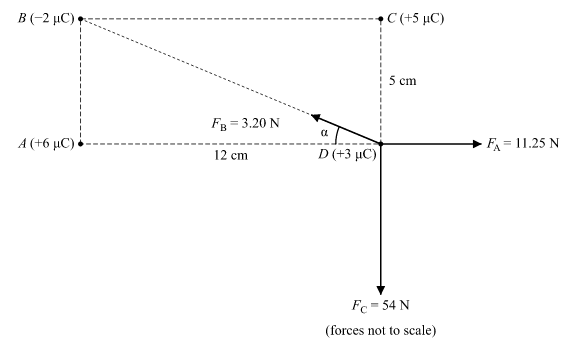
F=4πε01r2q1q2,4πε01=9.0×10⁹N m2C−2AD =0.12m, CD =0.05m, BD =0.122+0.052=0.13mForce due to A (repulsion, along AD produced):FA=0.1229×109×6×10−6×3×10−6=11.25NForce due to C (repulsion, along CD produced):FC=0.0529×109×5×10−6×3×10−6=54NForce due to B (attraction, towards B), with cosα=1312, sinα=135:FB=0.1329×109×2×10−6×3×10−6=3.20NResolve along AD produced (x) and along CD produced (y):Fx=11.25−3.20×1312=11.25−2.95=8.30NFy=54−3.20×135=54−1.23=52.77NF=8.302+52.772=53.4Ntanϕ=8.3052.77⇒ϕ=81.1∘The resultant is 53.4N at 81.1∘ to AD produced, on the side away from C (between AD produced and CD produced)(d)(3 marks)Charge resides on the outer surface and its surface density is greatest where the curvature is greatestField intensity at the surface is E=ε0σ, so it is greatest at the pointed (sharply curved) end and least at the broad, flatter endAt the sharp end the field may be strong enough to ionise the air (corona discharge); the field is everywhere perpendicular to the surface(e)(1 mark)1. Electrostatic precipitators (removing dust and smoke from chimney gases)2. Photocopiers (xerography); also lightning conductors and electrostatic spray paintingAnswer: (b)(i) U=4πε0rQq; (c) 53.4N at 81.1∘ to AD producedTip: Draw each force on the charge first (repulsion away, attraction towards), then resolve