What we are solvingCapacitance; charging graph; energy stored by a graphical method
A charged capacitor shares its charge with an identical capacitor containing a dielectric
εr: show the energy in the dielectric capacitor
Capacitance by a vibrating reed switch; ballistic galvanometer throw when a dielectric (
εr=2.5) fills half the plate area and the p.d. changes from
75 V to
120 V; water as dielectric
Chapter: Capacitors
Topic: charging, energy stored, dielectrics, measurement of capacitance
(a) (1 mark)Capacitance is the ratio of the charge on either plate to the p.d. between the plates:
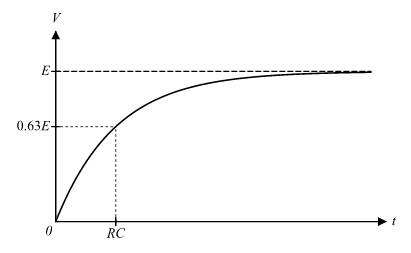
C=VQ(b)(i) (1 mark)(b)(ii) (1 mark)The p.d. rises quickly at first, then more and more slowly, approaching the e.m.f.
E (exponential growth
V=E(1−e−t/RC))
The rate falls because the growing capacitor p.d. opposes the battery and reduces the charging current;
V=0.63E after one time constant
RC(b)(iii) (4 marks)Since
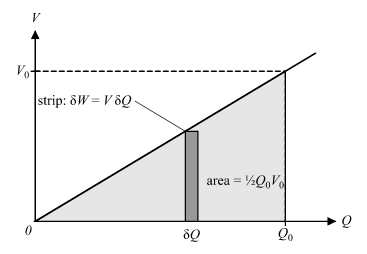
V=CQ, a graph of
V against
Q is a straight line through the origin
To add a small charge
δQ at p.d.
V, the work done is
δW=VδQ, the area of the thin strip
Total work done in charging from 0 to
Q0 = area under the graph = area of the triangle
W=21Q0V0With
Q0=CV and
V0=V:
W=21CV2(c) (3 marks)Initial charge:
Q=CVThe dielectric capacitor has capacitance
εrC; in parallel the total capacitance is
C+εrC=C(1+εr)Charge is conserved, so the common p.d. is
V′=C(1+εr)CV=1+εrVEnergy in the capacitor with the dielectric:
W=21(εrC)V′2=21εrC(1+εr)2V2=2(1+εr)2εrCV2(d) (4 marks)1. The reed switch vibrates at frequency
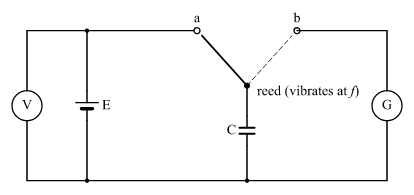
f, connecting C alternately to the battery (contact a) and to the galvanometer G (contact b)
2. At a, C charges to the battery p.d.
V (read on the voltmeter):
Q=CV3. At b, C discharges fully through G, so a charge
CV passes through G
f times a second
4. G reads the steady average current
I=fCVC=fVI(Repeat for several
V, plot
I against
V: gradient
=fC)
(e)(i) (4 marks)Throw of a ballistic galvanometer is proportional to the charge:
θ∝Q=CVHalf the area has air (capacitance
21C0) and half has the dielectric (capacitance
21εrC0), side by side in parallel:
C=2C0+22.5C0=1.75C00.6θ=C0×751.75C0×120=2.8θ=0.6×2.8=1.68 rad(e)(ii) (2 marks)Ordinary water contains ions and conducts electricity, so charge leaks between the plates and the capacitor discharges
Water is also a liquid that evaporates and cannot support or separate the plates rigidly
Answer: (b)(iii)
W=21CV2; (d)
C=fVI; (e)(i)
θ=1.68 radTip: A dielectric covering part of the area acts as capacitors in parallel; one filling part of the gap acts as capacitors in series