What we are solvingResistivity and temperature coefficient of resistance
A
1050 Ω voltmeter across a carbon filament (
375 Ω at
20 ∘C); ammeter
0.76 A, voltmeter
150 V at
1200 ∘C: find the hot resistance and the mean temperature coefficient
Verifying Ohm's law; I-V graph of a thermistor; limits of the Wheatstone and metre bridges
Chapter: Current electricity
Topic: resistance and its variation with temperature, measurement of resistance
(a)(i) (1 mark)Resistivity is the resistance of a material of unit length and unit cross-sectional area:
ρ=lRA, unit
Ω m(a)(ii) (1 mark)Temperature coefficient of resistance is the fractional change in resistance at
0 ∘C per kelvin rise in temperature:
α=R0θRθ−R0(b)(i) (4 marks)The ammeter reads the total current; part of it flows through the voltmeter
IV=1050150=0.1429 AIlamp=0.76−0.1429=0.6171 AR1200=0.6171150=243 Ω(b)(ii) (3 marks)Use
Rθ=R0(1+αθ) at both temperatures and divide:
R1200R20=1+1200α1+20α ⇒ 243.06375=1+1200α1+20α375+450000α=243.06+4861α445139α=−131.94 ⇒ α=−2.96×10⁻⁴ K−1The negative sign shows the resistance of carbon decreases as temperature rises
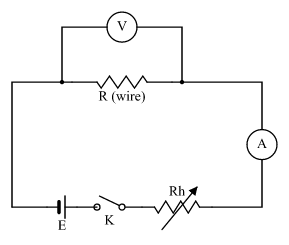
(c)(i) (4 marks)1. Connect the resistance wire R in series with an ammeter A, a rheostat Rh, a key K and a cell; connect a voltmeter V across R
2. Close K and adjust the rheostat; record the current
I and the p.d.
V3. Repeat for several rheostat settings, keeping the temperature of R constant (short current flow, wire in a water bath)
4. Plot
V against
I: a straight line through the origin shows
V∝I, verifying Ohm's law
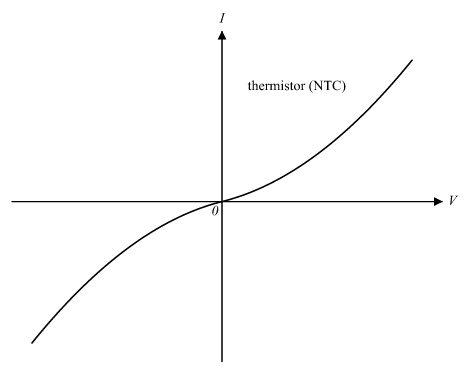
(c)(ii) (1 mark)The curve passes through the origin and bends towards the current axis: the gradient
VI increases as
V increases
(c)(iii) (2 marks)As the p.d. increases, the current heats the thermistor (a semiconductor)
The rise in temperature frees more charge carriers, so its resistance falls and the current rises faster than the p.d.
(d)(i) (2 marks)For a small resistance, the resistances of the connecting wires and the contact resistances at the terminals are comparable to the resistance being measured
so they cause large errors in the result
(d)(ii) (2 marks)Near the middle both balance lengths
l and
(100−l) are large, so the fixed reading error gives the smallest percentage error
and end errors (at the junctions of the wire and the copper strips) have the least effect; the bridge is also most sensitive there
Answer: (b)(i)
243 Ω; (b)(ii)
α=−2.96×10⁻⁴ K−1Tip: Always subtract the voltmeter current when the voltmeter is connected directly across the resistor