What we are solvingMagnetic field: definition and an experiment for the field round a current-carrying conductor
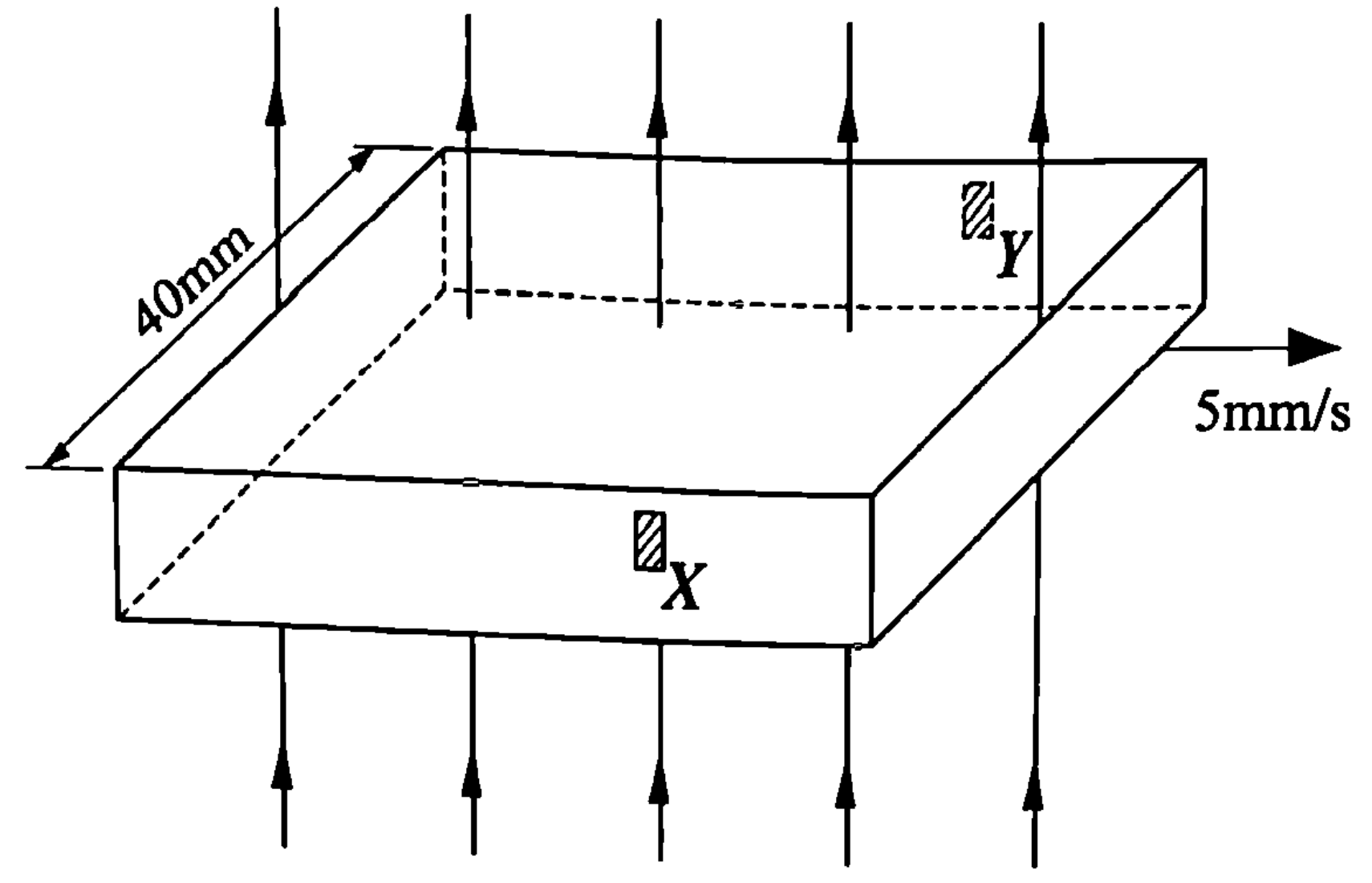
A metal bar of width
40 mm moves at
5 mm s−1 in a vertical field;
6 μV appears between X and Y: explain it and find B
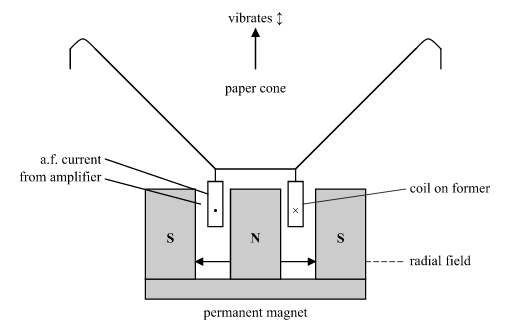
Moving coil loudspeaker; magnetic meridian; a 500-turn coil of diameter
6 cm turned through
180∘ gives
4.8 μC through
9 Ω: find
BHChapter: Magnetism and electromagnetic induction
Topic: magnetic fields, induced e.m.f., earth's magnetic field
(a)(i) (1 mark)A magnetic field is a region (space) in which a magnetic force is experienced by a magnetic material, a moving charge or a current-carrying conductor
(a)(ii) (3 marks)1. Pass a thick straight wire vertically through a hole in a horizontal sheet of cardboard
2. Sprinkle iron filings on the card, switch on a large current and tap the card gently
3. The filings arrange themselves in concentric circles round the wire; plotting compasses on the card point along these circles and reverse when the current is reversed
This shows a magnetic field exists round the current-carrying conductor
(b)(i) (2 marks)The free electrons in the bar move with the bar, perpendicular to the vertical field
Each experiences a magnetic force
Bev across the bar (Fleming's left-hand rule), so electrons collect on one side and the other side becomes positive
This charge separation sets up a p.d. between X and Y, growing until the electric force balances the magnetic force (an induced e.m.f.
E=BLv)
(b)(ii) (3 marks)E=BLv ⇒ B=LvEE=6×10⁻⁶ V,
L=40 mm=0.040 m,
v=5 mm s−1=5×10⁻³ m s−1B=0.040×5×10−36×10−6=2×10−46×10−6=0.03 T(c) (7 marks)Construction: a cylindrical permanent magnet has a central pole (N) and a ring pole (S), giving a strong radial field in the annular gap
A light coil wound on a former sits in the gap and is fixed to a paper cone held by a flexible rim to the frame
Operation: audio-frequency (a.f.) current from the amplifier flows in the coil
The coil carries current perpendicular to the radial field, so it feels a force
F=BIl along its axis
As the current alternates, the force reverses, so the coil and cone vibrate back and forth at the frequency of the current
The vibrating cone produces compressions and rarefactions in the air: sound of the same frequency
A larger current gives a larger force and amplitude, so a louder sound; the radial field makes the force proportional to the current, so the sound is undistorted
(d)(i) (1 mark)The magnetic meridian is the vertical plane containing the axis of a freely suspended magnet at rest under the earth's field alone (the vertical plane containing the earth's magnetic field at that place)
(d)(ii) (3 marks)Concept: flux linkage
NΦ=NABH through the coil; turning through
180∘ reverses it, so the change is
2NABHCharge through a ballistic galvanometer:
Q=Rchange in flux linkage=R2NABHA=πr2=π×0.032=2.83×10⁻³ m2,
N=500,
R=9 Ω,
Q=4.8×10⁻⁶ CBH=2NAQR=2×500×2.83×10−34.8×10−6×9=1.53×10⁻⁵ TKey point: For
BH to link the coil, its face must start facing the magnetic meridian (normal along
BH); the
180∘ turn about a horizontal axis then reverses the flux. A coil lying in the meridian links no
BH flux
Answer: (b)(ii)
B=0.03 T; (d)(ii)
BH=1.53×10⁻⁵ TTip: Convert mm and mm s
−1 to m and m s
−1 before using
E=BLv