What we are solvingStudents saw a magnified image in a compound microscope
The microscope was in normal adjustment
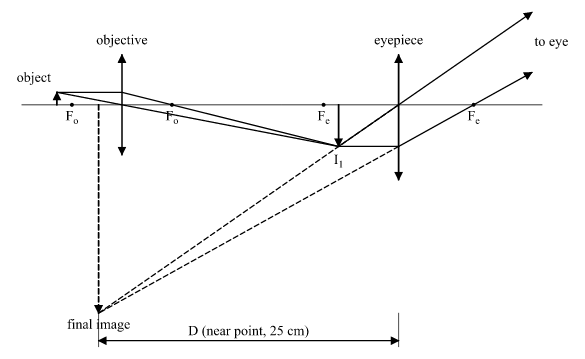
Part 1 asks for a ray diagram that shows how the image is formed
Part 2 asks us to derive the formula for the magnification
Chapter: Light
Topic: The compound microscope
Concept and formulasA compound microscope has 2 converging lenses
The lens near the object is the objective, with a short focal length
The other lens, close to the eye, is the eyepiece
Normal adjustment means the final image is at the near point of the eye
The near point distance is called D
For a normal eye, D is 25 cm
u1+v1=f1m=uvAnswer: the ray diagramDraw the principal axis and the 2 lenses
Place the object just outside the focus of the objective
The objective forms a real, inverted, magnified image, I 1
This image falls inside the focus of the eyepiece
So the eyepiece works as a magnifying glass
It forms a virtual final image, larger still, at distance D
The object is magnified twice, and that is why the image is so large
Answer: the formulaM=αβα=Dhβ=Dh2M=hh2M=h1h2×hh1=me×moThe first part is the eyepiece magnification
The second part is the objective magnification
Now use the lens formula
uv+1=fvuv=fv−1mo=fovo−1For the eyepiece, the image is virtual, at distance D
me=feD+1M=(fovo−1)(feD+1)That is the formula for the magnification
ConclusionThe objective makes a real enlarged image
The eyepiece enlarges it again, as a virtual image at the near point
The total magnification is the product of the 2
In a ray diagram, draw real rays with full lines
Draw the virtual image with broken lines
Answer: M = (v₀/f₀ − 1)(D/fₑ + 1)