Show Para
Hide Para
Question Numbers: 8-9Item 4Senior five Physics class was divided into two groups. Group 1 was taken to the laboratory, given a specimen on a slide. Their teacher told them to observe the specimen using a compound microscope that was set in normal adjustment. The students observed that the image was magnified by a reasonable factor. They wondered how the microscope in that setting was able to produce such a magnified image.
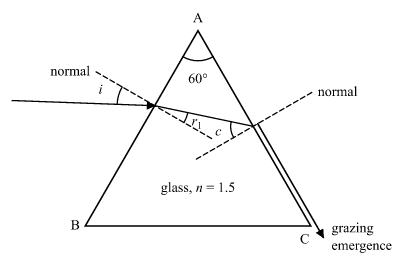
Group 2 students were expected to design an optical device in which light is incident on the first face of a triangular glass prism of refracting angle
60∘ and refractive index 1.5. One of the key conditions was that, the light ray grazes the second face of the prism. The students did not know how the required angle of incidence at the first face is obtained, in order to direct the incident ray accordingly.
Solution:
What we are solvingLight enters a glass prism of angle 60 degrees and refractive index 1.5
Inside, it must just graze the second face
We find the angle of incidence at the first face
Concept and formulasGrazing means the ray leaves along the surface, at 90 degrees to the normal
That happens when the angle inside the glass is the critical angle, c
sinc=n1r1+r2=Asini=nsinr1Workingsinc=1.51=0.6667c=41.8∘This is the angle r 2 at the second face
r1=60∘−41.8∘=18.2∘sini=1.5sin18.2∘sini=1.5×0.3122=0.468i=27.9∘ConclusionThe students of group 2 need an angle of incidence of 27.9 degrees
At that angle, the ray inside meets the second face at the critical angle
So it grazes along that face
Grazing along a face means the angle inside is the critical angle
Start from the second face and work back
Answer: 27.9°
© africaexams.com