What we are solvingA
5.0 Ω power resistor in Joseph's radio must be replaced
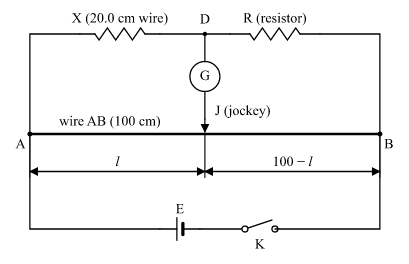
Joseph has a bare wire instead of a new resistor
We must find the resistance of
20.0 cm of that wire with a metre bridge
Then decide whether it can replace the
5.0 Ω resistor
Chapter: Current electricity
Topic: Wheatstone bridge principle and the metre bridge
Concept and formulasA metre bridge is a Wheatstone bridge made with a uniform wire
AB of length
100 cmAt balance no current flows through the galvanometer G
The wire is uniform, so resistance of a piece of it is proportional to its length
RX=100−llX = resistance of the
20.0 cm of bare wire (in the left gap), in
ΩR = known resistor in the right gap, in
Ωl = balance length measured from end A, in cm
Rearranging gives a straight-line form:
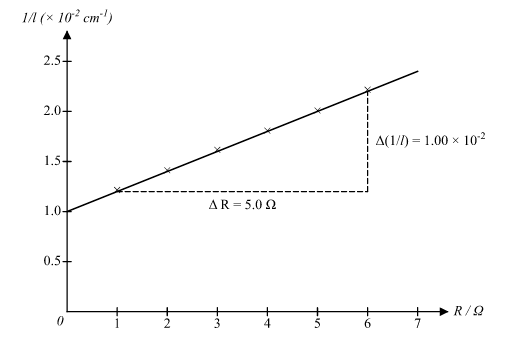
l100−l=XR ⇒ l1=100X1R+1001So a graph of
l1 against
R is a straight line
slope=100X1 ⇒ X=100×slope1The intercept on the
l1 axis should be
1001=1.0×10⁻² cm−1 (a check on the work)
Working: the procedure1. Measure and cut
20.0 cm of the bare wire; scrape its ends clean
2. Connect it firmly in the left gap of the metre bridge (this is
X)
3. Put a resistor
R=1.0 Ω in the right gap
4. Connect a cell E and a key K across the ends A and B of the bridge wire
5. Connect the galvanometer G from the junction D (between the gaps) to the jockey J
6. Close K; slide J along AB, tapping lightly, until G shows no deflection
7. Record the balance length
l from end A; open K between readings so the wire does not heat
8. Repeat with
R=2.0,3.0,4.0,5.0 and
6.0 Ω (series or parallel combinations of the resistors provided)
9. Record the results in a table and plot
l1 against
RWorking: resultsSample readings (your own readings will differ):
| R (Ω) | l (cm) | 100−l (cm) | l1 (×10−2 cm−1) |
|---|
| 1.0 | 83.2 | 16.8 | 1.20 |
| 2.0 | 71.5 | 28.5 | 1.40 |
| 3.0 | 62.4 | 37.6 | 1.60 |
| 4.0 | 55.7 | 44.3 | 1.80 |
| 5.0 | 50.1 | 49.9 | 2.00 |
| 6.0 | 45.4 | 54.6 | 2.20 |
The points lie on a straight line:
Slope from two points far apart on the line,
(1.0, 1.20×10⁻²) and
(6.0, 2.20×10⁻²):
slope=6.0−1.0(2.20−1.20)×10−2slope=5.01.00×10−2=2.00×10⁻³ cm−1Ω−1Resistance of the
20.0 cm of wire:
X=100×2.00×10−31X=0.2001=5.0 ΩCheck: intercept read from the graph
≈1.0×10⁻² cm−1=1001, as expected
Each single reading also gives
X=100−lRl between
4.95 and
5.03 ΩConclusionThe
20.0 cm of bare wire has resistance
X≈5.0 Ω, equal to the resistor that must be replaced
So the wire is fit for purpose: the technician should fit
20.0 cm of it in place of the
5.0 Ω power resistor
If your
X is not
5.0 Ω, the wire is not fit at
20.0 cmIt could still be used cut to the length
L=X5.0×20.0 cm, since resistance is proportional to length
A power resistor gets warm, so the wire should be held firmly and not touch other parts of the radio
Answer: Sample result
X=5.0 Ω for
20.0 cm of wire, so the wire is fit for purpose
Tip: Choose
R values so the balance point falls near the middle of the wire (about 30 to 70 cm); end errors are then smallest