What we are solvingThe factory needs the density of
liquid W; it must lie between
950 and
1050 kg m−3Method I finds the mass of
100 cm3 of the liquid with a metre rule balanced on a knife edge
Then density
ρ1 = mass ÷ volume
Chapter: Mechanics (statics) and properties of matter
Topic: Principle of moments; density
Concept and formulasThe metre rule is balanced at its balance point C, so its own weight acts at C and has no moment about C
Principle of moments: for balance, clockwise moments about C = anticlockwise moments about C
m1x=m2yx,
y = distances (cm) of the two loads from C;
m1,
m2 = masses (g) of the loads
(the factor
g cancels on both sides)
ρ=volumemassWorking: procedure and readingsSample readings (your own readings will differ):
(a) Balance point of the metre rule:
C=50.2 cm mark (sample)
(b) Empty beaker on one side,
m=100 g on the other, rule balanced at C:
Beaker at
x0=30.0 cm from C;
100 g mass at
y0=22.5 cm from C
mbx0=my0mb=30.0100×22.5=75.0 g(c) Pour
100 cm3 of
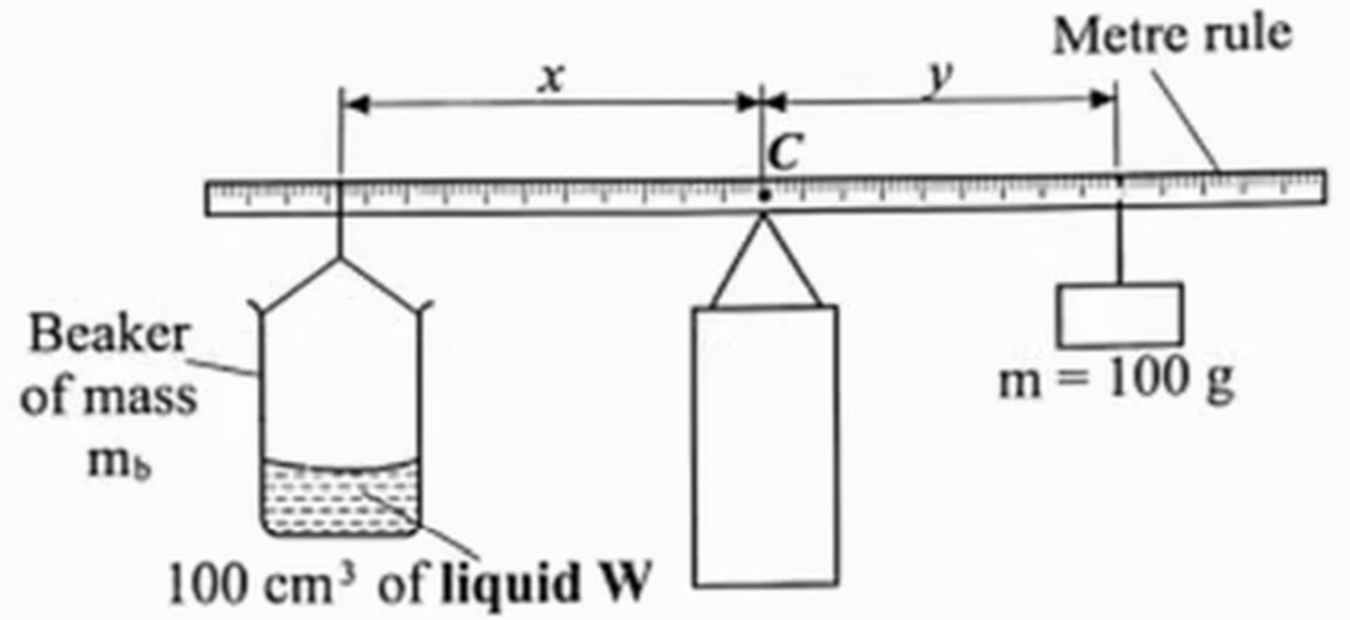
liquid W (measured with a measuring cylinder) into the beaker and balance again (Fig. 1)
(d) Distances:
x=20.0 cm,
y=35.4 cmWorking: mass and density(e) Moments about C with the liquid in the beaker:
(mb+mw)x=mymb+mw=20.0100×35.4=177.0 gmw=177.0−75.0=102.0 g(f) Density of
liquid W:
ρ1=Vmw=100 cm3102.0 g=1.02 g cm−3ρ1=1.02×1000=1020 kg m−3Conclusion(g) The value of
ρ1 is only fairly accurate (to about
±2%):
The volume
100 cm3 is read from a measuring cylinder to about
±1 cm3 (
±1%), and some liquid stays on the cylinder walls
Distances are read to
±0.05 cm on a metre rule, and the exact point of support of the thread is hard to judge
Friction at the knife edge lets the rule rest at slightly different positions
mb comes from a separate balance, so its error is carried into
mwSo
ρ1 should be checked by a second method (Method II)
Answer: Sample result
mb=75.0 g,
mw=102.0 g,
ρ1≈1020 kg m−3 (fairly accurate, about
±2%)
Tip: Keep the masses far from C (large
x and
y); the percentage error in each distance is then small