Question Numbers: 2-4Item 2A certain factory is known for producing a particular type of fluid. During the process of production, the fluid from the first phase has to be diluted with liquid W before it is packaged. For liquid W to qualify to be used for diluting the fluid, its density must be in the range 950kg m−3 and 1,050kg m−3.A company that was contracted by the factory to supply liquid W has delivered a sample for testing. However, the factory manager needs help to verify whether the sample passes the test.You are provided with a sample of liquid W.
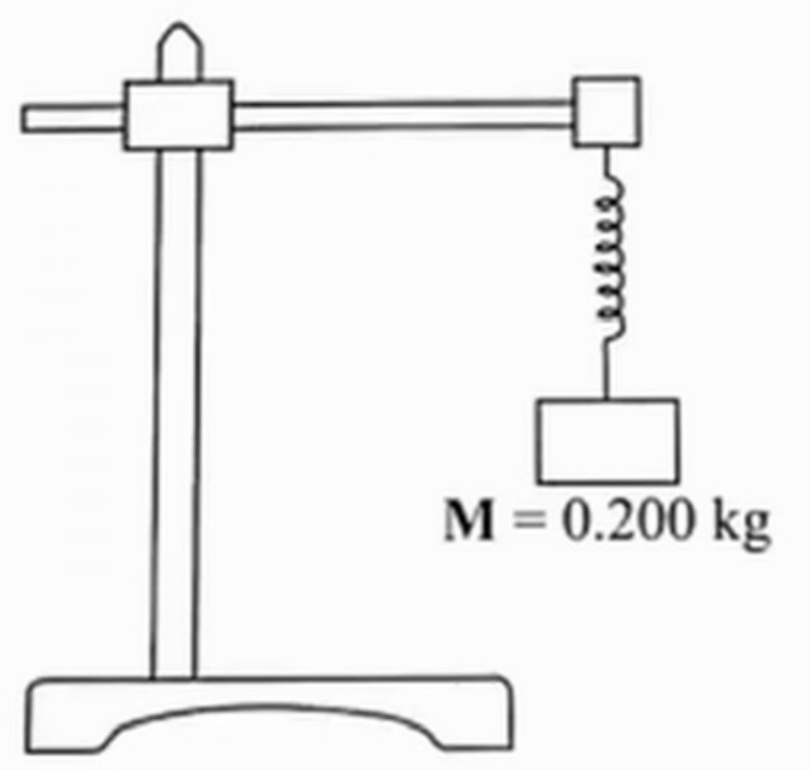
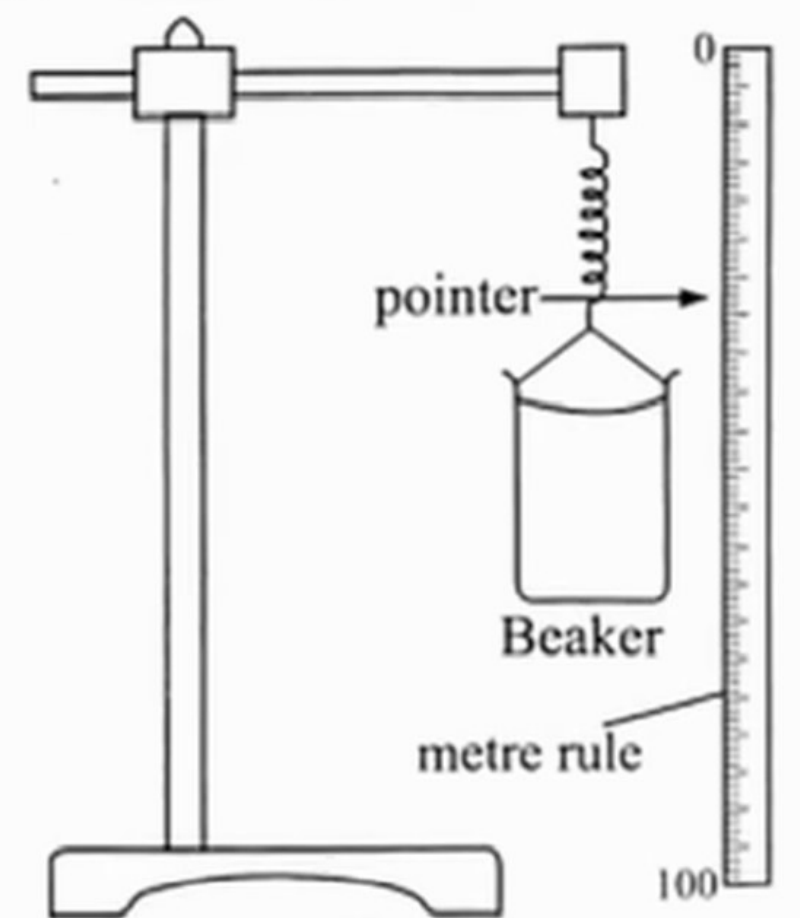
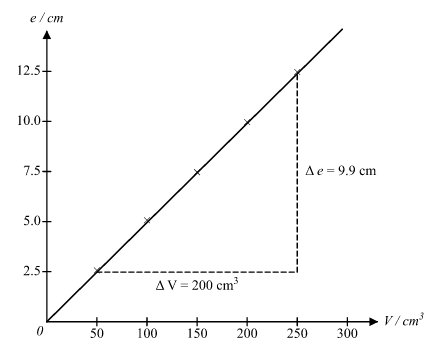
What we are solvingMethod II finds the density of liquid W a second way, using a springFirst the oscillations of a 0.200kg mass give the force constant K of the springThen the extension of the spring for different volumes of liquid gives the slope s of an e against V graphFinally ρ2=gKsChapter: Oscillations (simple harmonic motion) and elasticityTopic: Mass on a spring; Hooke's law; densityConcept and formulasA mass on a spring moves with simple harmonic motion of periodT=2πKM⇒K=T24π2MT = period (s), M = mass (kg), K = force constant (N m−1)Hooke's law: the added weight of the liquid stretches the spring by eKe=mg=ρVg⇒e=KρgVSo e against V is a straight line through the origin with slope s=Kρgρ2=gKss must be in SI units (m per m3, i.e. m−2) to give ρ2 in kg m−3Working: force constant (a) to (e)Sample readings (your own readings will differ):Hang M=0.200kg, pull it down a little and release; start timing when it passes its rest position(c) Time for 20 oscillations: t=12.6s(d) Period:T=20t=2012.6=0.630s(e) Force constant:K=0.63024π2×0.200K=0.39697.896=19.9N m−1Working: extensions (f) to (l)Replace M by the empty beaker; fix a horizontal pointer at the lower end of the spring beside the vertical metre rule (Fig. 3)(h) Initial pointer position (empty beaker): Po=30.0cm(i), (j) Pour 50cm3 of liquid W into the beaker; read the new pointer position P at eye level; e=P−Po(k), (l) Repeat for 100,150,200,250cm3 and tabulate:
V(cm3)
Pointer position P(cm)
e=P−Po(cm)
50
32.5
2.5
100
35.0
5.0
150
37.4
7.4
200
39.9
9.9
250
42.4
12.4
Working: graph and density (m) to (o)(m) The graph of e against V is a straight line through the origin:
(n) Slope from the points (50,2.5) and (250,12.4) on the line:s=250−5012.4−2.5=2009.9=0.0495cm per cm3Change to SI units (1cm=10−2m, 1cm3=10−6m3):s=0.0495×10−610−2=495m−2(o) Density from Method II:ρ2=gKs=9.8119.9×495ρ2≈1004kg m−3ConclusionMethod II gives ρ2≈1004kg m−3 (sample)It uses five readings and a graph, so random errors are averaged outAnswer: Sample result T=0.630s, K≈19.9N m−1, s=495m−2, ρ2≈1004kg m−3Tip: Convert the slope to SI units before using ρ2=gKs; leaving it in cm per cm3 gives a value 104 times too small