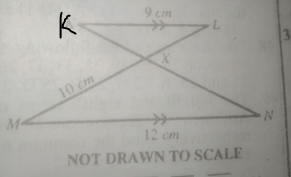
Concept:Since MN∥KL, △MXN and △LXK are similar triangles.For similar triangles, the ratio of their areas equals the square of the ratio of their corresponding sides.Explanation:The corresponding sides are MN and KL. Their lengths are 12cm and 9cm.Thus, the ratio of the areas is:Area(△LXK)Area(△MXN)=(912)2=81144.Given that the area of △MXN is 16cm2, we substitute:Area(△LXK)16=81144.Cross-multiply and solve:Area(△LXK)=14416×81.Simplify:Area(△LXK)=1441296=9.Hence, the area of △LXK is 9cm2.Answer:A. 9cm2