Item 6 (a)What we are solvingSam crossed two breeds of ducks, and later bred their offspring
The knotweed poisoned the adult ducks, but not the ducklings
Then Sam sprayed the thicket
This task has two parts
In part one, we explain the ratio of ducklings, and the different effect of the knotweed
In part two, we explain how the spray changed the energy flow
Chapter: Genetics and ecology
Topic: Inheritance of linked characters; energy flow
Concept: dominance, linkage and energy flowWhen 2 pure breeds are crossed, the character that shows in all the offspring is
The hidden character is recessive
One gene: 3 to 1
Two separate genes: 9 to 3 to 3 to 1
But 2 genes on the same chromosome are linked
Linked genes are inherited together
Then 2 characters behave like one
Energy enters an ecosystem as sunlight
sunlight → producers → consumers → decomposers
It then flows to primary consumers, and on to secondary consumers
At every step, most of the energy is lost as heat
When organisms die, the energy in their bodies passes to decomposers
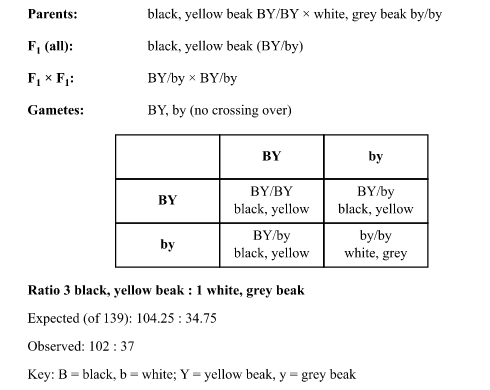
Working: the proportions of phenotypesBlack ducks with yellow beaks mated with white ducks with grey beaks
All the ducklings were black with yellow beaks
Black is dominant to white
These ducklings are the first generation
Each one is heterozygous
The first generation ducks then bred together
102 were black with yellow beaks, and 37 were white with grey beaks
102:37=2.76:1≈3:1That is close to 3
So the ratio is about 3 to 1
Check it against the total
43×139=104.25,41×139=34.75One quarter is about 35
The observed numbers, 102 and 37, are close to these
The small difference is due to chance at fertilisation
Now notice what is missing
There are no black ducks with grey beaks
There are no white ducks with yellow beaks
Only the two parental types appear
So feather colour and beak colour are inherited together
The two genes are linked on the same chromosome
Let capital B stand for black and small b for white
Let capital Y stand for a yellow beak and small y for grey
Each first generation duck makes only 2 kinds of gamete
One carries B with Y
The other carries small b with small y
3 of the 4 boxes have the dominant alleles
One box has only recessive alleles
That gives 3 black with yellow beaks, to 1 white with a grey beak
Working: the ducks and the ducklingsThe adult ducks escaped and ate many fruits at one time
Adult ducks: one large dose, above the lethal level
Their livers could not break it down fast enough, and they died
The ducklings ate only a few leaves and fruits at a time, but often
Ducklings: small repeated doses, tolerance builds up
The liver broke the poison down each time
Repeated small doses also make the liver produce more of the enzymes that destroy the
So the ducklings built up tolerance, and were unharmed
There is one more point
The ducklings were hybrids of 2 breeds
Hybrids are often stronger than either parent breed
This is called hybrid vigour
Working: the energy flowLook at the food chain
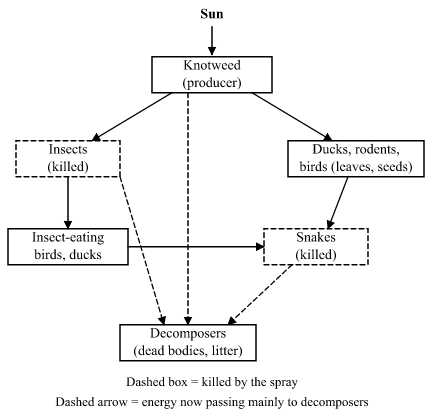
The knotweed is the producer
Insects feed on it, so they are primary consumers
Birds eat the insects, and snakes eat the birds and their eggs
The chemical killed the insects and the snakes, but not the knotweed
With the insects gone, energy no longer passes from the knotweed to the consumers
Energy stays locked in the thicket
Dead insects and snakes: energy to decomposers
The insect eating birds lose their food
They leave, starve, or turn to Sam's crops
With the snakes gone, the animals they used to eat increase
The poison in dead insects can also pass to the birds that eat them
So the spray did not remove the thicket
It only broke the flow of energy through the food chain
ConclusionBlack feathers and a yellow beak are dominant, and their genes are linked
So the first generation gave 3 black with yellow beaks
The adults died from one large dose
The ducklings met small doses, and became tolerant
The spray removed the consumers, so energy stayed in the knotweed
Count the phenotypes before you choose the ratio
2 phenotypes from 2 characters point to linkage
Answer: 3 : 1 ratio; spray broke the food chain